
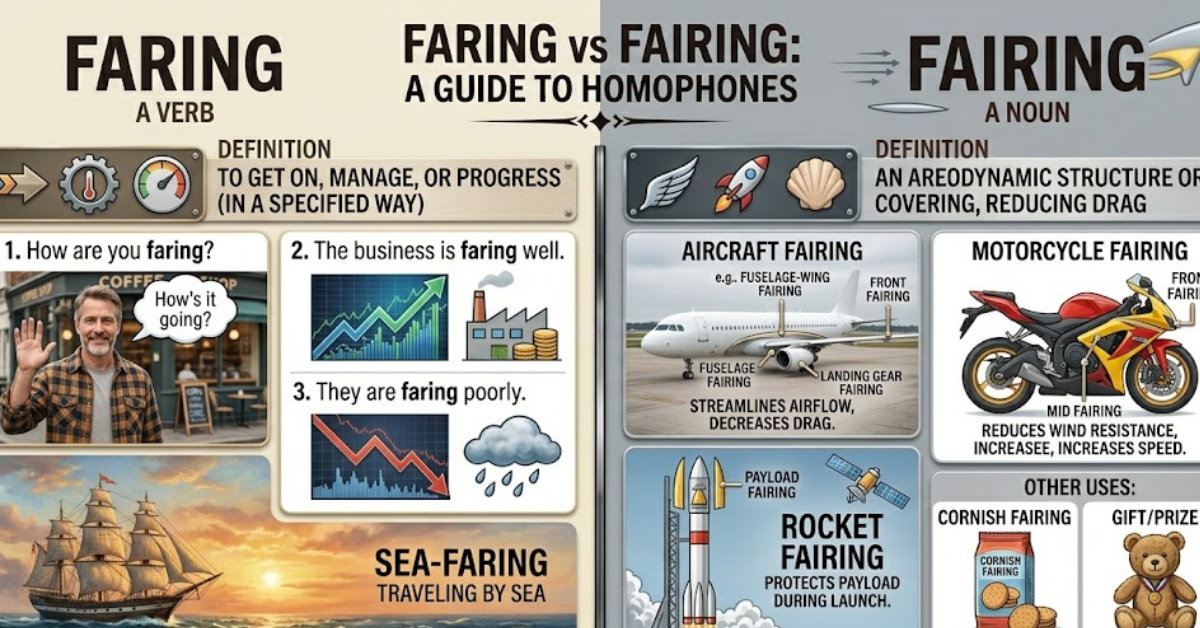

If you’ve ever come across the words Faring vs Fairing and paused for a second, you’re not alone. These two terms look almost identical, but they belong to completely different worlds of meaning. One is a verb used in everyday English, while the other is a noun often found in engineering and aviation.
The focus keyword Faring vs Fairing is commonly searched because people want a clear explanation without confusing grammar jargon. Once you understand the difference, you’ll never mix them up again.
In this guide, we’ll break everything down in a simple, conversational way so you can confidently understand and use both words correctly.
What Does Faring Mean?
To understand Faring vs Fairing, we first need to look at “faring.”
Faring definition:
“Faring” comes from the verb “fare,” which means:
- To perform or progress in a certain way
- To manage or get along in a situation
- To experience a condition or outcome
Examples:
- How are you faring in your new job?
- She is faring well after the surgery.
So, “faring” is about how someone is doing or progressing in life or a situation.
What Does Fairing Mean?
Now let’s look at the second part of Faring vs Fairing.
Fairing definition:
A “fairing” is a physical object, not a verb. It is commonly used in:
- Engineering
- Aviation
- Automotive design
Meaning:
A fairing is a structure added to vehicles or machines to reduce air resistance or improve aerodynamics.
Examples:
- The motorcycle has a sleek fairing for better speed.
- The aircraft’s fairing reduces drag.
So unlike “faring,” fairing is a noun related to design and structure.
Faring vs Fairing Difference Explained Simply
The Faring vs Fairing difference becomes very clear when you compare their usage:
Faring:
- Verb form
- Talks about progress or condition
- Used in everyday English
Fairing:
- Noun form
- Refers to a physical structure
- Used in technical fields
Simple comparison:
- How are you faring? (How are you doing?)
- The bike has a fairing. (Part of the bike design)
Common Mistakes in Faring vs Fairing Usage
People often confuse Faring vs Fairing because of their spelling.
Common errors:
- Writing “fairing” when talking about someone’s health
- Writing “faring” when referring to vehicle parts
- Mixing both in casual writing
Tip to avoid mistakes:
- If it’s about people → faring
- If it’s about machines → fairing
Faring in Everyday English Usage
The word “faring” is mostly used in conversation and writing when asking about well-being.
Examples:
- How are you faring in your studies?
- He is not faring well financially.
- The team is faring better this season.
It is a flexible word used to describe progress or condition.
Fairing in Real-Life Applications
The word “fairing” is more technical and appears in industries like:
Uses:
- Aircraft design (to reduce drag)
- Motorcycles (for speed and protection)
- Rockets and spacecraft (for aerodynamics)
Example:
- The rocket’s nose fairing protects its payload during launch.
So in Faring vs Fairing, fairing belongs to engineering language.
Easy Trick to Remember Faring vs Fairing
Here’s a simple memory trick:
Think:
- Faring = Feeling / Doing (people)
- Fairing = Form / Frame (machines)
This helps you instantly identify which word to use.
Why Faring vs Fairing Confuses People
The confusion happens because:
- They sound almost identical
- They differ by only one letter
- Both are valid English words
- Context is not always clear
But once you understand their meaning, the confusion disappears.
Faring or Fairing in Real Sentences
Let’s compare both in real usage:
Faring:
- She is faring well in her new school.
- How are you faring today?
Fairing:
- The airplane’s fairing reduces wind resistance.
- The motorcycle fairing is damaged.
This side-by-side view makes the distinction clear.
Quick Summary of Faring vs Fairing
To simplify everything:
- Faring → How someone is doing
- Fairing → Physical structure on vehicles
- One is a verb, the other is a noun
- Completely different meanings despite similar spelling
FAQs on Faring vs Fairing
1. What is the difference between Faring or Fairing?
Faring refers to progress or condition, while fairing is a physical part used in vehicles or machines.
2. Is faring a real word?
Yes, faring comes from the verb “fare,” meaning to progress or manage.
3. What is a fairing in simple words?
A fairing is a part of a vehicle designed to reduce air resistance.
4. Why do people confuse Faring or Fairing?
Because they sound similar and differ by only one letter.
5. Can I use fairing in daily conversation?
Not usually. It is mostly used in technical or engineering contexts.
Conclusion
Understanding Faring vs Fairing becomes easy once you separate their meanings. “Faring” is about how someone is doing or progressing, while “fairing” is a technical term used for parts in vehicles and machines.
The key takeaway is simple: one belongs to everyday human language, and the other belongs to engineering. Once you remember this difference, you’ll never confuse them again.
If you want to improve your English further, practicing similar confusing word pairs can make your grammar much stronger and more confident over time.