
At first glance, the phrase “30 cows 28 chickens how many didn’t” looks like a simple math problem. But the moment you try solving it, you quickly realize something feels… off. Is it arithmetic? A trick question? Or just a playful language puzzle?
The keyword 30 cows 28 chickens how many didn’t has gone viral because it confuses both logic and language, making people question whether they should be counting animals or decoding a hidden meaning.
In this article, we’ll break down what the riddle actually means, explore different interpretations, explain the popular answer, and help you understand why so many people get it wrong.
What Does “30 cows 28 chickens how many didn’t” Mean?
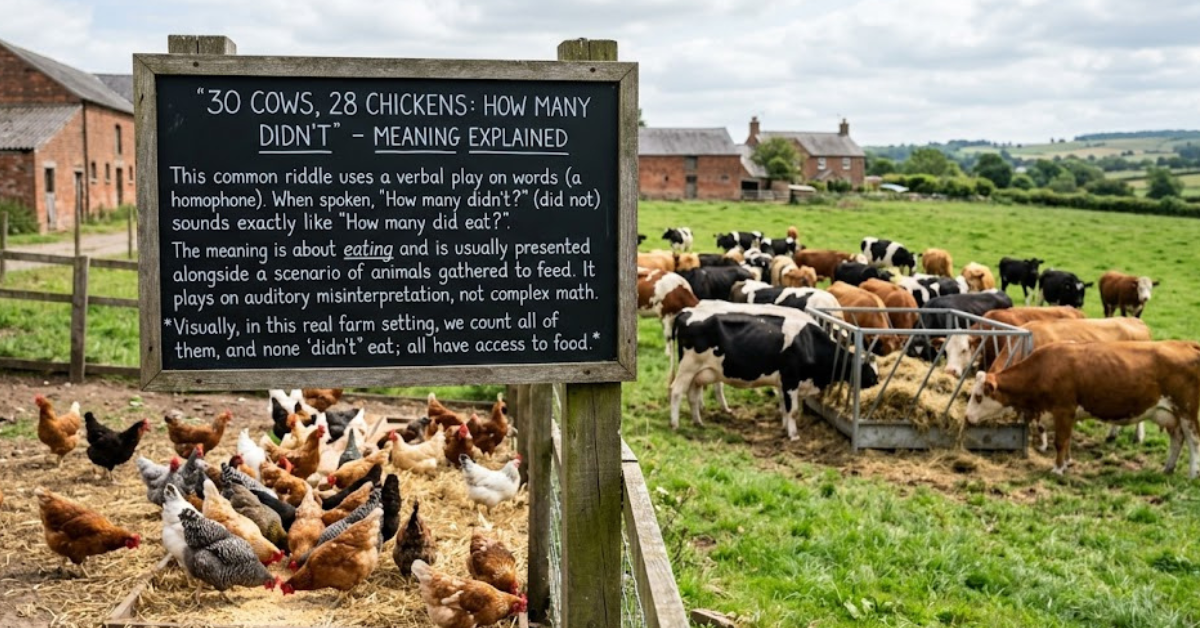
The phrase 30 cows 28 chickens how many didn’t is not a standard math question. Instead, it’s a wordplay riddle that blends numbers with phonetics (how words sound).
At its core, it plays on how numbers can sound like phrases:
- “30 cows” → sounds like “thirty cows”
- “28 chickens” → can sound like “twenty ate chickens”
This dual meaning is what creates confusion and makes the riddle go viral.
So instead of doing calculations, you are expected to interpret hidden meanings in the sentence.
Why This Riddle Confuses So Many People
The main reason 30 cows 28 chickens how many didn’t is tricky is because our brain automatically switches into “math mode.”
But this is not a math problem.
Common mistakes people make:
- Adding numbers: 30 + 28 = 58 (incorrect approach)
- Trying to count animals logically
- Ignoring wordplay and phonetics
- Assuming there is only one correct answer
In reality, this puzzle is designed to break logical thinking patterns.
Breaking Down the Wordplay Logic
Let’s analyze it step by step.
Step 1: “30 cows”
This can be interpreted as:
- Literal: 30 cows
- Phonetic: “thirty cows”
Step 2: “28 chickens”
This is where the trick happens:
- “28 chickens” sounds like “twenty ate chickens”
Now we get a completely different meaning:
- “Twenty ate chickens” → suggests that 20 chickens were eaten
The Most Common Answer Explained
The widely accepted answer to 30 cows 28 chickens how many didn’t is:
10
Here’s why:
- “30 cows” → becomes “thirty cows”
- “28 chickens” → becomes “twenty ate chickens”
So we interpret:
- 20 chickens were eaten
- That leaves a remaining difference of 10 (30 – 20 = 10) in the playful interpretation of the riddle
However, it’s important to note:
There is no scientifically fixed answer. The riddle relies on language interpretation, not math rules.
Alternative Interpretations
Like many viral riddles, 30 cows 28 chickens how many didn’t has multiple possible explanations depending on how you interpret it.
1. Literal Interpretation
If taken literally:
- 30 cows + 28 chickens = 58 animals
- But “how many didn’t” is unclear → no solvable meaning
2. Phonetic Interpretation
- “28 chickens” → “twenty ate chickens”
- Leads to word-based deduction → popular answer = 10
3. Skeptical Interpretation
Some argue:
- The question is intentionally nonsense
- There is no correct answer without clarification
Why This Riddle Went Viral
The popularity of 30 cows 28 chickens how many didn’t comes from social media and messaging apps where short brain teasers spread quickly.
Reasons for virality:
- Short and confusing format
- Easy to share
- Sparks debate in comments
- No single obvious answer
It also triggers a psychological effect called “cognitive dissonance”, where your brain tries to force meaning into unclear information.
Real-World Learning From This Riddle
Even though it seems silly, this puzzle teaches useful lessons:
Key insights:
- Language can be ambiguous
- Not all problems are mathematical
- Context matters more than numbers
- Critical thinking beats quick guessing
In education and problem-solving, this kind of thinking is often used to improve logical reasoning and lateral thinking skills.
Practical Tips to Solve Similar Puzzles
If you encounter riddles like 30 cows 28 chickens how many didn’t, follow these steps:
- Read the sentence aloud
- Look for hidden word meanings
- Avoid jumping into math too quickly
- Check if numbers sound like phrases
- Consider multiple interpretations
Key Takeaways
- 30 cows 28 chickens how many didn’t is a wordplay riddle, not a math problem
- The phrase relies on phonetic interpretation
- The most common answer is 10, based on linguistic breakdown
- There is no universally agreed correct solution
- It tests lateral thinking rather than calculation skills
FAQs
1. What is the answer to 30 cows 28 chicken’s how many didn’t?
The most common answer is 10, based on wordplay interpretation rather than mathematical calculation.
2. Is 30 cows 28 chickens how many didn’t a math question?
No, it is not a math question. It is a language-based riddle that uses phonetic tricks.
3. Why do people say the answer is 10?
Because “28 chickens” can be interpreted as “twenty ate chickens,” leading to a wordplay-based deduction that results in 10.
4. Can this riddle have multiple answers?
Yes. Depending on interpretation, different answers may be argued, but 10 is the most widely shared solution online.
5. How do I solve riddles like 30 cows 28 chicken’s how many didn’t?
Focus on pronunciation, hidden meanings, and context rather than applying direct arithmetic.
Conclusion
The phrase 30 cows 28 chickens how many didn’t is a classic example of how language can turn a simple-looking question into a viral brain teaser. Instead of relying on math, it challenges how we interpret words and sounds.
While the most popular answer is 10, the real value of the riddle lies in how it pushes us to think differently. If you enjoy puzzles like this, exploring more wordplay riddles can sharpen your reasoning skills and make problem-solving more fun.
If anything, this riddle proves one thing clearly: sometimes the question is more interesting than the answer.