
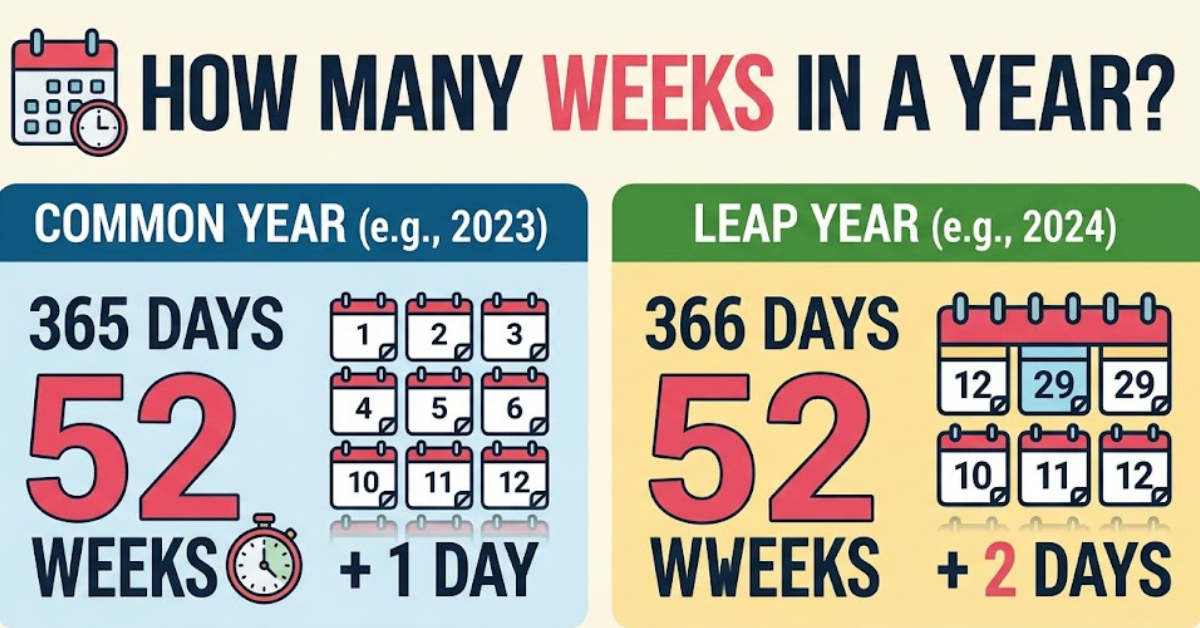

If you’ve ever wondered about the number of weeks in a year, you’re not alone. It’s a simple question, but the answer is surprisingly useful in everyday life—especially when dealing with calendars, salaries, and planning schedules.
At first glance, the answer seems straightforward, but a few small details make it more interesting. Let’s break it down clearly.
How Many Weeks Are in a Year?
A standard year has:
- 365 days (366 in a leap year)
- 7 days in a week
When you divide 365 by 7:
You get approximately 52.14 weeks
So, in simple terms:
A year has 52 weeks, plus a little extra.
That small extra fraction is why calendars don’t divide perfectly into full weeks.
Why There Are 52 Weeks
A year does not split evenly into weeks.
Breakdown:
- 52 full weeks = 364 days
- 1 extra day in a normal year
- 2 extra days in a leap year
This is why calendars usually round it to 52 weeks.
Weeks in Different Years
2024
- Leap year (366 days)
- 52 weeks + 2 extra days
2025
- Normal year (365 days)
- 52 weeks + 1 extra day
2026
- Normal year (365 days)
- 52 weeks + 1 extra day
So the structure stays the same, with only small variations in extra days.
Importance in Payroll and Salary
In HR and finance, this calculation is very important.
Most systems use:
- 52-week annual structure
- 26 biweekly pay periods
This is why salary planning is usually based on 52 weeks, even though the exact day count is slightly higher.
Biweekly Pay System
In a biweekly payroll system:
- Employees are paid every 2 weeks
- 52 ÷ 2 = 26 pay periods
So there are 26 payments per year in this system.
Half-Year Calculation
For half-year planning:
- 52 ÷ 2 = 26 weeks
So half a year is approximately 26 weeks.
Working Days in a Year
If weekends are excluded:
- 52 weeks × 5 working days = 260 working days
So the weekly structure stays the same, but working days are reduced.
Simple Calculation Method
A basic way to calculate weeks in a year:
- 365 ÷ 7 = 52.14
This confirms why 52 is used as the standard reference.
Real-Life Importance
Knowing this helps in:
- Salary planning
- School schedules
- Project timelines
- Budgeting
- Fitness planning
Even though it seems simple, it is widely used in real-world systems.
FAQs
How many weeks are in a year?
There are 52 weeks, plus about one extra day.
Is a year exactly 52 weeks?
No, it is approximately 52.14 weeks.
Why do we use 52 weeks?
Because it is the closest full-week approximation.
How many weeks in a leap year?
Still 52 weeks, with 2 extra days.
How many pay periods in a year?
26 in a biweekly system.
How many weeks in half a year?
About 26 weeks.
Conclusion
A year is commonly understood as 52 weeks, even though the exact calculation shows a small remainder of extra days. This standard is used in calendars, payroll systems, education, and planning because it is simple and practical.
Understanding this helps you manage time, schedules, and financial planning more effectively in everyday life.