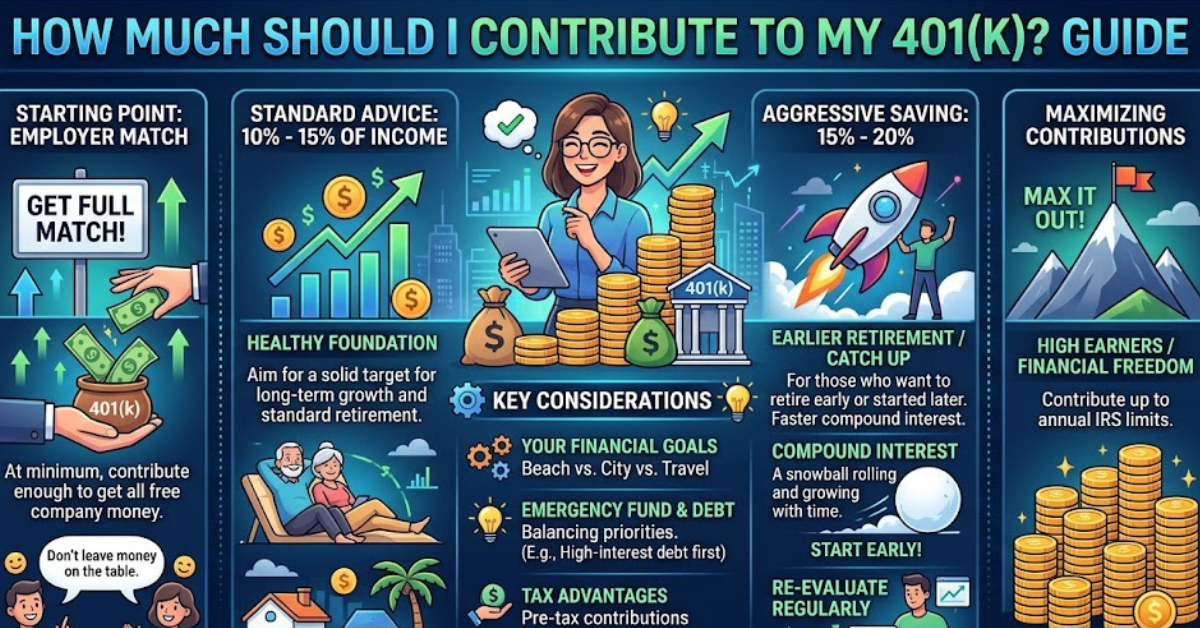

Ever looked at your paycheck and wondered if you’re putting away too little—or maybe even too much—for retirement? You’re not alone. Figuring out how much should i contribute to my 401k is one of the most common financial questions people face when building long-term security.
At its core, this decision affects your future lifestyle, retirement age, and financial freedom. In this guide, you’ll learn how to determine the right contribution amount based on your income, age, employer match, and financial goals—without overcomplicating things.
Understanding 401(k) Contributions
A 401(k) is an employer-sponsored retirement savings plan that lets you invest a portion of your paycheck before or after taxes (depending on whether it’s traditional or Roth). Over time, your money grows through compound interest and investment returns.
When people ask how much should i contribute to my 401k, the answer isn’t one-size-fits-all. It depends on your financial situation, but there are strong guidelines that can help you make a confident decision.
Key elements include:
- Employer matching contributions
- IRS annual contribution limits
- Your monthly budget and expenses
- Long-term retirement goals
Key Factors That Determine Your Contribution Amount
1. Employer Match Free Money You Shouldn’t Ignore
If your employer offers a match, this is your first priority. For example, if they match 5% and you only contribute 3%, you’re leaving free money on the table.
A smart rule: contribute at least enough to get the full match before thinking about anything else.
2. Income and Monthly Budget
Your day-to-day financial health matters. Rent, debt payments, and emergency savings should come before maximizing retirement contributions.
When evaluating how much should i contribute to my 401k, think in percentages rather than fixed dollar amounts—this makes it easier to adjust as your income changes.
3. Age and Time Until Retirement
The earlier you start, the less you need to contribute monthly thanks to compound growth. If you start later, you may need to save more aggressively.
4. Roth vs Traditional 401(k)
Your tax situation also plays a role. A Roth 401(k) may be better if you expect higher taxes later, while a traditional 401(k) reduces your taxable income now.
Common Rules of Thumb for 401(k) Contributions
Financial planners often suggest:
- Start with at least 10% of your income
- Aim for 15% over time (including employer match)
- Always capture the full employer match first
So when people ask how much should i contribute to my 401k, a practical range is usually between 10% and 20% depending on financial stability and age.
Age-Based Contribution Strategy
In Your 20s
Focus on starting early. Even 5%–10% is powerful due to compounding growth.
In Your 30s
Increase to around 10%–15% as your income grows and financial stability improves.
In Your 40s and 50s
You may need to reach 15%–20% if you’re catching up on retirement savings.
At every stage, the real answer to how much should i contribute to my 401k shifts based on income growth, debt levels, and lifestyle needs.
Smart Strategy: How to Decide Your Ideal Contribution
Here’s a simple step-by-step approach:
- Check your employer match and contribute enough to get it
- Build a 3–6 month emergency fund
- Pay off high-interest debt
- Increase contributions gradually (1–2% yearly)
- Aim for long-term target (10–15% or more)
This balanced approach ensures you’re saving for retirement without hurting your present financial stability.
Common Mistakes to Avoid
- Not taking full advantage of employer matching
- Setting contributions too low and never increasing them
- Cashing out early when changing jobs
- Ignoring investment allocation inside the 401(k)
- Overlooking fees and plan options
Avoiding these mistakes can dramatically improve your retirement outcome.
Key Takeaways
- Start with your employer match first
- Aim for 10%–15% as a long-term goal
- Increase contributions as income grows
- Start early to maximize compound growth
- Balance retirement savings with current financial needs
FAQs
1. How much should i contribute to my 401k to retire comfortably?
Most experts recommend saving 10%–15% of your income, including employer match. The exact amount depends on your retirement age and lifestyle goals.
2. Is 6% enough for a 401(k)?
6% is a starting point, especially if your employer matches part of it. However, increasing it over time is usually necessary for long-term retirement security.
3. What happens if I contribute too much to my 401(k)?
If you exceed IRS limits, you may face penalties and taxes. Most payroll systems prevent this, but it’s still important to monitor contributions.
4. Should I max out my 401(k) every year?
If you can afford it, maxing out is ideal. But it’s more important to balance savings with emergency funds and debt repayment.
5. How often should I increase my contribution?
A good habit is increasing it by 1% every year or whenever you get a raise.
Conclusion
Deciding how much should i contribute to my 401k isn’t about hitting a perfect number—it’s about building a sustainable habit that grows with you. Start with your employer match, aim for steady increases, and adjust based on your life stage and financial goals.
The earlier and more consistently you contribute, the more freedom you give your future self.