
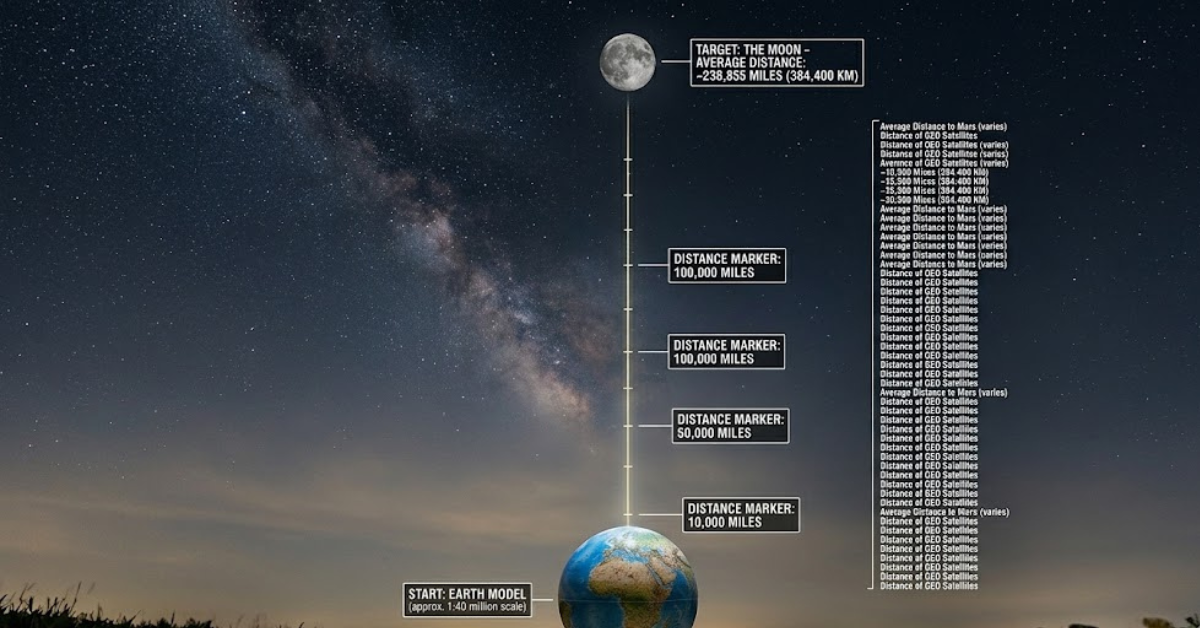

If you’ve ever looked up at the night sky and wondered about the Moon’s distance, you’re not alone. It’s a simple question, but the answer is more interesting than most people expect.
People often search about the Moon’s distance from Earth because they want to understand how far our closest celestial neighbor actually is. The key detail is that the Moon does not stay at a fixed distance—it constantly changes as it orbits Earth.
In this guide, we break down distances in miles, kilometers, light-seconds, and more, along with how the orbit affects those numbers.
Distance Between Earth and the Moon
The average distance between Earth and the Moon is:
- 238,855 miles
- 384,400 kilometers
- About 1.28 light-seconds
This value represents an average because the Moon follows an elliptical orbit around Earth.
Distance in Miles, Kilometers, and Meters
Here’s a simple breakdown of lunar distance:
- Miles: ~238,855 miles
- Kilometers: ~384,400 km
- Meters: ~384,400,000 meters
These numbers show just how large space becomes even over relatively “close” celestial distances.
Closest and Farthest Points of the Moon
It’s orbit creates two key positions:
Closest point (Perigee)
- ~225,623 miles (363,300 km)
Farthest point (Apogee)
- ~251,968 miles (405,500 km)
This variation explains why the Moon sometimes appears slightly larger or smaller in the sky.
Why the Distance Changes
The Earth–Moon distance changes because:
- The Moon follows an elliptical orbit
- Gravitational forces constantly influence its path
- Its position shifts throughout each month
So there is no single fixed number—only a moving range.
Distance in Light Years
Compared to cosmic scales, the Moon sits extremely close to Earth.
- ~0.00000004 light years away
This tiny value exists because one light year equals about 5.88 trillion miles, making lunar distance extremely small in astronomical terms.
Distance From the Sun
The Moon does not orbit the Sun independently.
Instead:
- It travels with Earth around the Sun
- It stays roughly 93 million miles (149.6 million km) from the Sun
So its solar distance stays nearly identical to Earth’s.
How the Moon’s Distance Changes Over Time
The Moon slowly moves away from Earth each year.
- About 1.5 inches (3.8 cm) per year
This happens due to tidal interactions between Earth and the Moon.
Over millions of years, this gradual shift becomes significant.
Distance in Feet and Inches
For a more relatable idea of scale:
- ~1.26 billion feet
- ~15.1 billion inches
These numbers help visualize how far the Moon sits from Earth in everyday units.
Real-Time Distance
The Moon’s distance at any moment depends on:
- Its orbital position
- The time of observation
- Ongoing gravitational changes
In general, it stays within:
- 225,000 to 252,000 miles from Earth
Why Lunar Distance Matters
Understanding Earth–Moon distance helps in:
- Space missions and landings
- Satellite communication
- Tidal predictions
- Astronomical studies
Even small changes in distance can affect tides and eclipses.
Quick Summary
- Average distance: ~238,855 miles
- Closest: ~225,000 miles
- Farthest: ~252,000 miles
- Annual drift: ~1.5 inches
- Light travel time: ~1.28 seconds
FAQs
1. How far is it from Earth?
It sits about 238,855 miles (384,400 km) away on average.
2. Why does the distance change?
Its elliptical orbit causes the distance to vary between 225,000 and 252,000 miles.
3. How far is it in kilometers?
Around 384,400 km on average.
4. Does the Moon move away from Earth?
Yes, it drifts about 3.8 cm per year.
5. How long does light take to reach the Moon?
About 1.28 seconds.
Conclusion
The Moon may look close in the night sky, but it actually sits hundreds of thousands of miles away and slowly drifts farther over time.
Understanding lunar distance gives a clearer picture of Earth’s place in space and makes the night sky even more fascinating when you look up.