
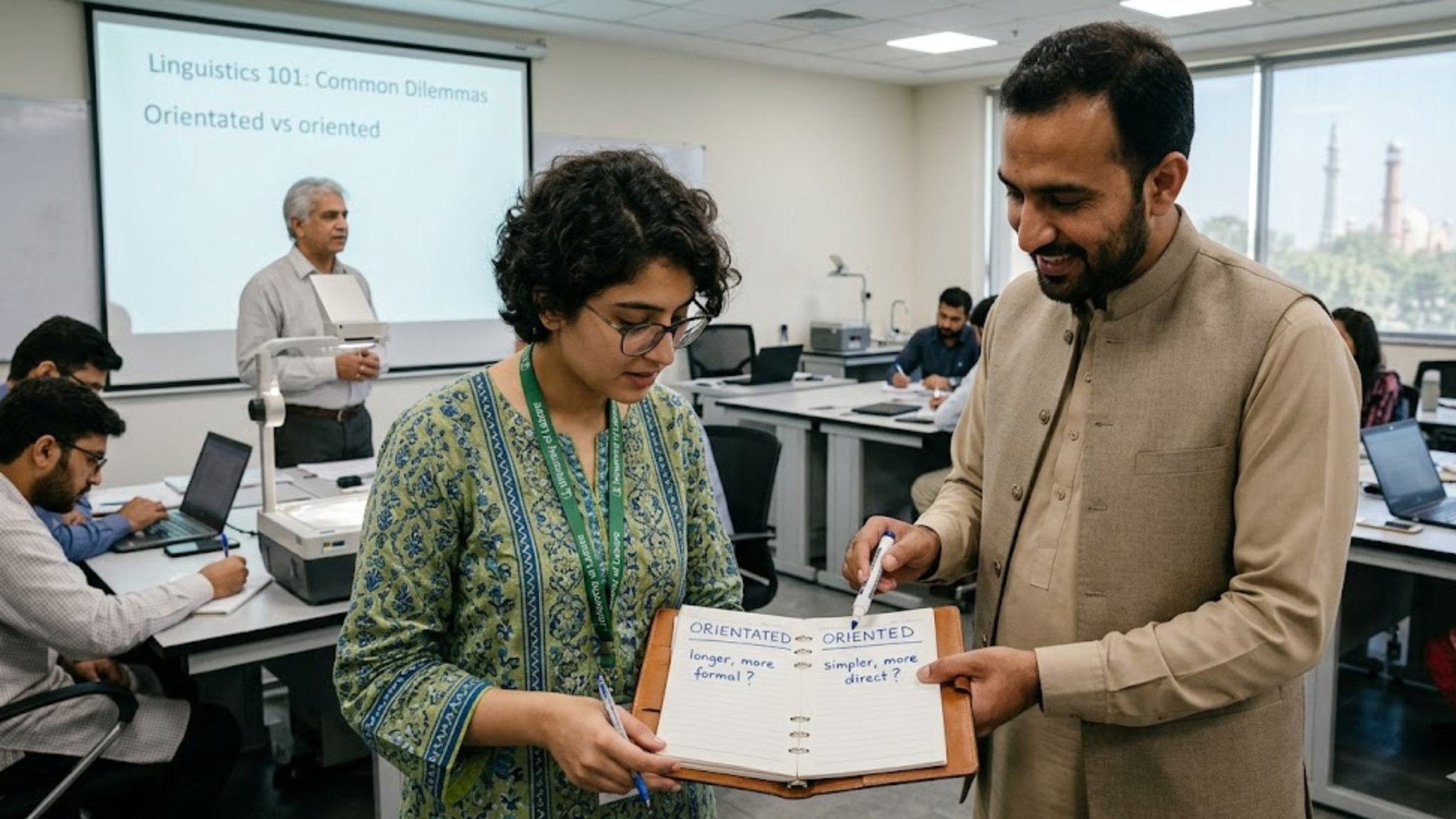

If you’ve come across the terms orientated vs oriented, you might wonder whether they mean the same thing or if one is incorrect. The good news is that both words exist in English, and both are correct. The difference mainly comes down to region and writing style.
In most cases, “oriented” is the standard form in American English, while “orientated” appears more often in British English. However, modern usage increasingly favors “oriented” in formal writing.
Let’s break it down clearly so you know exactly when to use each form.
Meaning of Orientated vs Oriented
Both words share the same meaning:
They describe something that is:
- aligned toward a direction or goal
- adjusted to a situation or environment
- focused on a specific purpose
Simple meaning:
Both terms describe being focused or directed toward something.
Are Both Forms Correct?
Yes, both forms are grammatically correct.
However:
- Writers in American English prefer “oriented”
- Writers in British English often use “orientated”
Neither form is wrong, but usage depends on context and audience.
UK English Usage
In British English, people commonly use “orientated” in informal speech.
Examples:
- She feels family orientated.
- He stays goal orientated in his work.
However, many UK style guides now encourage “oriented” in formal writing, especially in education and business.
US English Usage
American English consistently prefers “oriented.”
Examples:
- She is family oriented.
- He works in a detail oriented role.
Writers in the US rarely use “orientated,” and many consider it outdated or informal.
Family Oriented vs Family Orientated
This phrase appears often in search queries.
Both forms describe someone who values family highly.
Examples:
- She lives a family oriented lifestyle. (common in US/global English)
- He is a family orientated person. (UK informal usage)
In modern professional writing, “family oriented” appears more often.
Examples of Usage
Oriented (preferred in American/global English):
- The training program focuses on student oriented learning.
- The company follows a customer oriented approach.
- She works in a career oriented field.
Orientated (more common in British informal English):
- The course follows a student orientated method.
- He leads a family orientated life.
- The project uses a community orientated design.
Both forms communicate the same idea.
Simple Definition
Both words describe something that is:
- directed toward a goal
- structured around a focus
- adapted to a situation
In modern usage:
- “Oriented” sounds more standard and widely accepted
- “Orientated” sounds more regional and traditional
Usage in Canada
Canadian English blends British and American influence.
In practice:
- Writers use “oriented” in formal, academic, and business contexts
- Speakers may still use “orientated” in informal situations
For safety and clarity, most Canadian writing prefers “oriented.”
Why Two Versions Exist
Language evolution explains the difference.
- British English kept the longer form “orientated”
- American English simplified many verbs into shorter forms like “oriented”
Over time, global English shifted toward “oriented” in formal writing.
Which One Should You Use?
Use this simple rule:
Use “oriented” when:
- writing professionally
- writing for international readers
- unsure about your audience
“orientated” when:
- writing informal British English
- matching a UK-specific style guide
FAQs
What is the difference between orientated and oriented?
Both words mean the same thing. “Oriented” appears more in American and modern global English, while “orientated” appears more in British informal usage.
Is orientated correct?
Yes, it is grammatically correct, but it is less common in global formal writing.
Is oriented better than orientated?
In most professional and international contexts, yes. “Oriented” is preferred.
What is family oriented vs family orientated?
Both describe someone focused on family values. “Family oriented” is more widely used.
Is orientated used in the UK?
Yes, especially in informal speech, but “oriented” appears more in formal UK writing.
Which should I use in Canada?
“Oriented” works best in most professional Canadian contexts.
Conclusion
The difference between orientated vs oriented comes down to style, not correctness. Both words are valid and carry the same meaning. However, modern global English strongly favors “oriented,” especially in professional writing.
If you want a safe, widely accepted choice, use “oriented.” It fits well in business, academic, and international communication.