
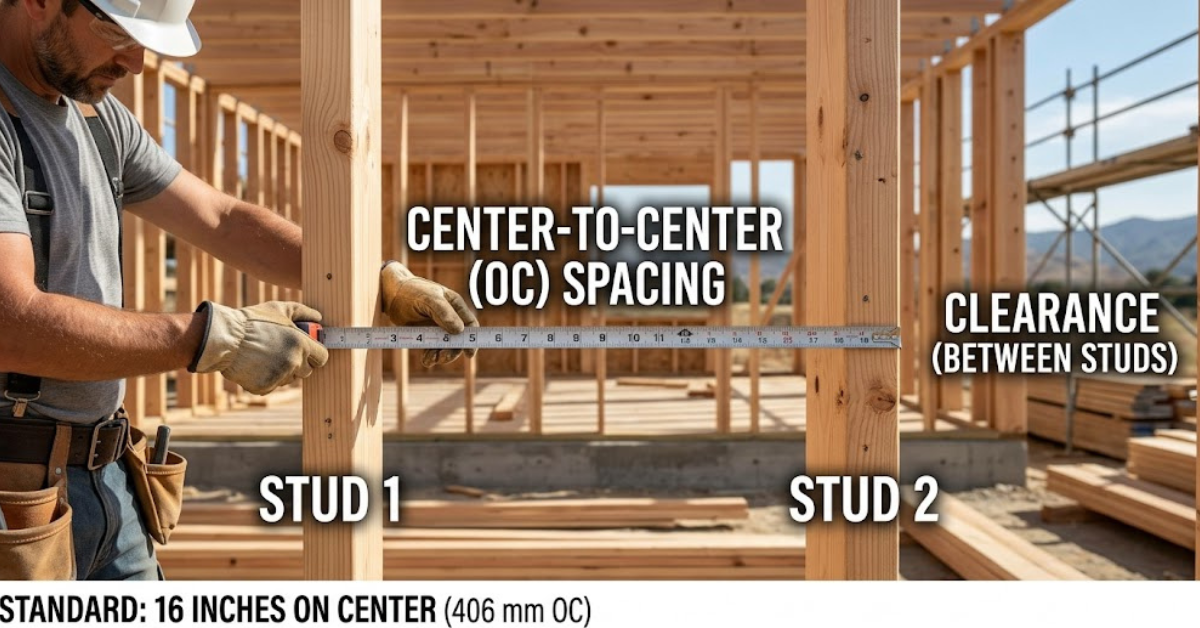

If you’ve ever tried hanging a shelf, TV, or heavy frame, you’ve probably wondered about wall stud spacing. Studs are the vertical framing pieces behind drywall that support your walls—and knowing their location is essential for safe mounting and home improvement work.
The good news is that most modern construction follows fairly standard stud spacing, although building type and age can cause some variation.
Standard Wall Stud Spacing
Most modern homes follow these common measurements:
- 16 inches on center (most common)
- 24 inches on center (used in some newer or energy-efficient buildings)
“On center” means builders measure from the center of one stud to the center of the next, rather than measuring the empty space between them.
Stud Spacing in Houses
Residential construction typically follows building codes and structural requirements:
- Most homes use 16-inch on-center spacing
- Some lighter or non-load-bearing walls use 24-inch spacing
Older homes often break these patterns, since builders used different methods and standards depending on the time period.
Stud Spacing in Apartments
Apartments generally follow similar framing standards as houses:
- Most interior walls use 16-inch spacing
- High-rise buildings often replace wood studs with steel framing
Even when builders switch materials, they usually maintain consistent spacing for structural stability.
Stud Spacing in Older Homes
Older homes tend to vary more in their construction. Instead of consistent spacing, you may notice:
- Slight irregularities in stud placement
- Spacing that ranges roughly from 14 to 17 inches
- Differences based on builder practices at the time
Because of this inconsistency, you shouldn’t rely on assumptions in older buildings.
Mid-Century Homes (1960s–1970s)
Homes built in this era usually follow more consistent framing practices:
- Most commonly use 16-inch spacing
- Regional construction styles can cause slight differences
- Some non-load-bearing walls use 24-inch spacing
Garages and Mobile Homes
Different structures often use slightly different framing approaches:
Garages:
- Most use 16-inch spacing
- Some lighter sections use 24-inch spacing
Mobile homes:
- Typically use 16-inch spacing
- Lightweight materials may create small variations
Why Stud Spacing Matters
Understanding wall framing helps you:
- Safely mount heavy items like TVs and shelves
- Prevent damage to drywall
- Plan renovations and drilling locations
- Identify strong support points inside walls
Drywall alone cannot safely support heavy loads.
How to Find Studs in a Wall
Even though spacing follows patterns, actual placement can still vary. Use these methods to locate studs accurately:
1. Use a stud finder
A stud finder gives the most reliable results.
2. Try the knock test
- Hollow sound indicates empty space
- Solid sound suggests a stud behind the wall
3. Measure from corners
Studs often sit at regular intervals, usually starting around 16 inches from a corner.
4. Look for electrical outlets
Electric outlets usually attach to the side of a stud.
Common Misconceptions
All walls follow exact spacing rules
This is not true—older and custom homes often vary.
You can always locate studs without tools
Drywall can be misleading, so guessing is unreliable.
Drywall can hold heavy objects safely
Drywall alone cannot support heavy loads without proper anchors.
Conclusion
Most modern homes follow a predictable framing pattern, with studs spaced 16 inches on center, while some newer designs use 24-inch spacing. However, older buildings and special constructions often differ.
Whenever you plan to drill or mount something, always confirm stud placement with a stud finder instead of relying on assumptions.
Understanding stud spacing helps you avoid wall damage and complete home improvement projects safely and confidently.