

Ever stared at a polynomial division problem and wondered if there’s a faster way than long division? You’re not alone. Many students find polynomial division time-consuming until they discover a shortcut method that changes everything.
In this guide, we’ll break down how to do synthetic division in a simple, practical way that actually makes sense. You’ll learn what it is, when to use it, and how to solve problems step by step without confusion. By the end, you’ll feel much more confident handling polynomial expressions quickly and accurately.
Understanding how to do synthetic division
Before jumping into calculations, it’s important to understand what synthetic division actually is.
Synthetic division is a simplified method used to divide a polynomial by a linear expression of the form (x − c). Instead of writing out every variable and exponent like in long division, you work only with the coefficients, making the process faster and cleaner.
This method is especially useful in algebra because it reduces clutter and speeds up computation when compared to traditional polynomial long division.
When to use synthetic division
You should use synthetic division when:
- You are dividing by a linear factor like (x − 2) or (x + 5)
- You only need coefficients, not full polynomial rewriting
- You want a faster alternative to polynomial long division
However, it won’t work for dividing by quadratic expressions or more complex divisors.
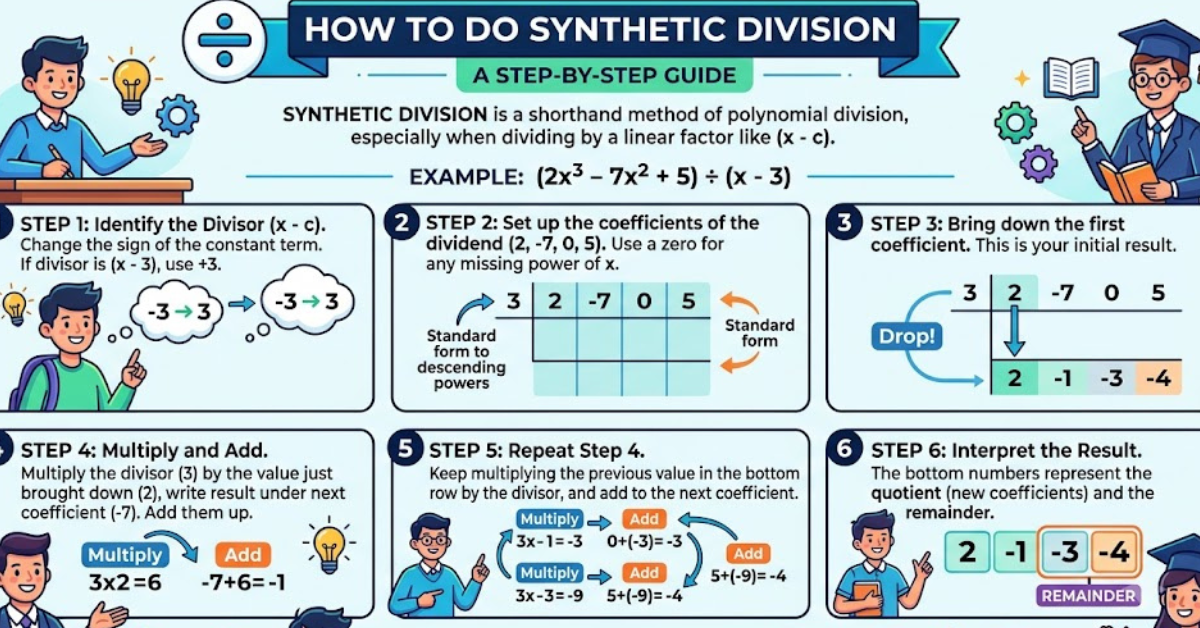
How to do synthetic division step-by-step
Now let’s get into the core process of how to do synthetic division in a clear, structured way.
Step 1: Write the coefficients
Start by listing the coefficients of the polynomial in descending order of powers. If any terms are missing, insert a zero as a placeholder.
Step 2: Identify the divisor value
If your divisor is (x − c), then the value you use is c. This number goes on the left side of the synthetic division setup.
Step 3: Bring down the first coefficient
This is the starting point of your calculation. Simply carry it down unchanged.
Step 4: Multiply and add
Multiply the number you brought down by the divisor value, then write the result under the next coefficient. Add vertically.
Step 5: Repeat the process
Continue multiplying and adding until you reach the end. The final row gives your quotient and remainder.
At this stage, you’ve essentially mastered the mechanical process of how to do synthetic division through repetition and pattern recognition.
Example problem
Let’s apply how to do synthetic division to a real example:
Divide:
x³ + 2x² − 5x − 6 by (x − 2)
Step-by-step:
- Coefficients: 1, 2, −5, −6
- Use value: 2
Now perform the steps:
- Bring down 1
- 1 × 2 = 2 → add to 2 = 4
- 4 × 2 = 8 → add to −5 = 3
- 3 × 2 = 6 → add to −6 = 0
Result:
Quotient = x² + 4x + 3, remainder = 0
This shows that (x − 2) is a factor of the polynomial.
Common mistakes to avoid
Even though the method is simple, students often make avoidable errors:
- Forgetting to include zero placeholders for missing terms
- Using the wrong sign for c in (x − c)
- Skipping steps in multiplication or addition
- Misaligning coefficients during setup
Being careful with setup is just as important as knowing how to do synthetic division itself.
Practical tips for mastering synthetic division
Here are a few tips to improve accuracy:
- Always double-check your polynomial is in standard form
- Write neatly to avoid misreading coefficients
- Practice with different types of polynomials
- Verify answers using multiplication or graphing tools
With enough practice, the process becomes almost automatic.
FAQs
1. What is synthetic division used for?
Synthetic division is used to divide polynomials by linear expressions like (x − c) in a faster, simplified way compared to long division.
2. Is synthetic division easier than long division?
Yes, in most cases it is faster and less error-prone once you understand the steps of how to do synthetic division properly.
3. Can synthetic divisions be used for any polynomial?
No, it only works when dividing by linear divisors. For higher-degree divisors, you must use polynomial long division.
4. Why do we use coefficients only?
Because synthetic divisions focuses on arithmetic patterns, using coefficients reduces complexity and makes calculations faster.
5. What happens if a term is missing in the polynomial?
You must insert a zero in its place to maintain correct positioning during the division process.
6. How do I know if the remainder is correct?
You can multiply the quotient by the divisor and add the remainder to verify your result matches the original polynomial.
Conclusion
Learning how to do synthetic division can significantly simplify polynomial division and save time during exams or assignments. Once you understand the pattern of multiplying and adding, the process becomes straightforward and reliable.
With practice, you’ll be able to solve problems quickly and even recognize factors of polynomials with ease. Keep practicing different examples, and this technique will soon feel natural and effortless.