
The sextant meaning refers to one of the most important tools in the history of navigation—a precision instrument used to measure angles between celestial objects and the horizon. For centuries, sailors relied on the sextant to find their position at sea long before GPS existed. Understanding the sextant meaning gives us insight into how explorers crossed oceans with remarkable accuracy using only the stars, mathematics, and careful observation.
At its core, a sextant is more than just a scientific device; it represents human curiosity, exploration, and the drive to navigate the unknown. In this article, we’ll break down what a sextant is, how it works, its historical significance, and why it still matters today.
What is the Sextant Meaning in Simple Terms?
The sextant meaning can be defined as:
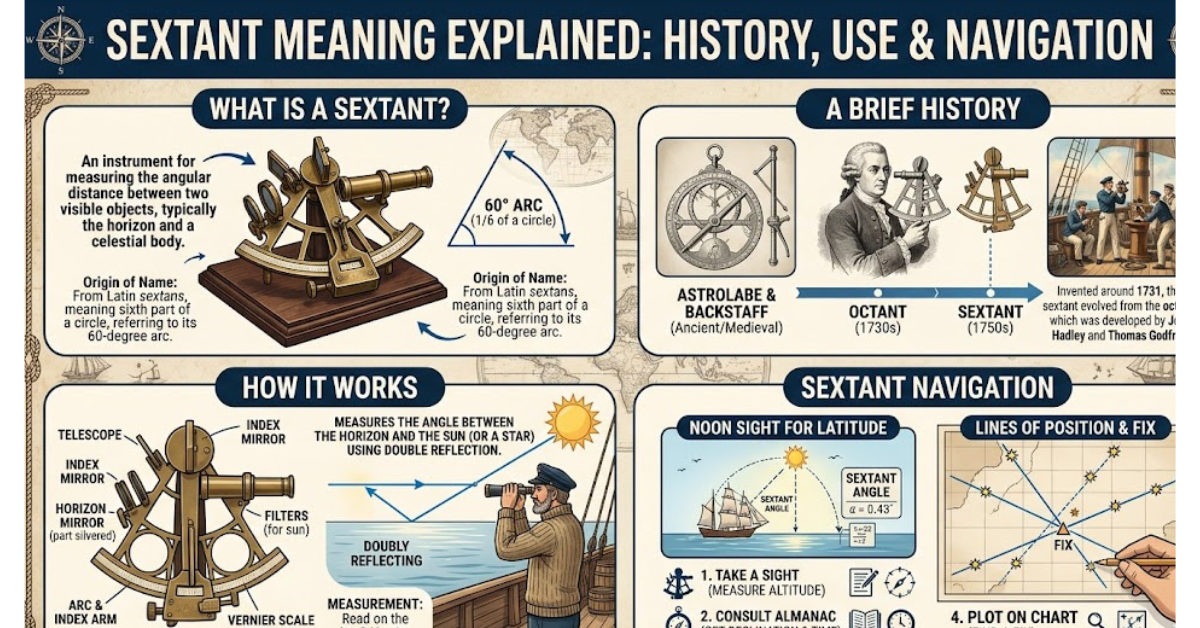
A handheld navigation instrument used to measure the angle between two visible objects, most commonly a celestial body and the horizon.
In simpler words, a sextant helps you figure out where you are on Earth by looking at the sky.
Key Idea Behind the Sextant
- It measures angular distance (not distance in miles or kilometers)
- It uses the horizon as a reference point
- It helps determine latitude and longitude (with calculations)
How Does a Sextant Work?
A sextant works on the principle of reflecting angles using mirrors. Even though it looks complex, its working concept is quite logical.
Basic Components of a Sextant
- Frame: The main structure shaped like a 60-degree arc
- Index Mirror: A movable mirror that reflects the object being observed
- Horizon Mirror: A half-silvered mirror that shows both sky and horizon
- Telescope: Helps the user view distant objects clearly
- Arc (Limb): The graduated scale used to measure angles
Step-by-Step Working Process
- The user looks through the telescope at the horizon.
- The index mirror is adjusted to reflect a celestial object (like the sun or a star).
- Both images align in the field of view.
- The angle is read from the scale on the arc.
- This angle is then used with nautical tables to determine position.
History and Origin of the Sextant
The sextant meaning is deeply connected to maritime history. The instrument was developed in the 18th century, evolving from earlier tools like the astrolabe and octant.
Who Invented the Sextant?
The modern sextant is credited to:
- John Bird (around 1757) – refined early designs
- Thomas Godfrey and others also contributed to its development
Why It Was Revolutionary
Before the sextant:
- Navigation was often guesswork
- Sailors relied on stars with limited accuracy
After the sextant:
- Ocean navigation became far more precise
- Global trade and exploration expanded rapidly
Importance of the Sextant in Navigation
Understanding the sextant meaning also means appreciating its role in global exploration.
Why Sailors Used It
- To determine latitude using the sun at noon
- To calculate position using stars at night
- To avoid getting lost in open oceans
Real-World Impact
- Enabled transoceanic voyages
- Supported naval military strategy
- Helped map the world more accurately
Sextant vs Modern GPS Navigation
Even though GPS has replaced traditional tools, the sextant is still respected.
Key Differences
| Feature | Sextant | GPS |
| Power Source | None | Satellite/Power |
| Accuracy | High (with skill) | Extremely high |
| Dependency | Celestial visibility | Technology |
| Use Today | Backup navigation, training | Everyday navigation |
Why It Still Matters
- Works without electricity
- Useful in emergencies
- Teaches foundational navigation skills
Practical Uses of a Sextant Today
While not common in daily life, the sextant still has modern relevance:
- Marine navigation training
- Aviation history education
- Survival and emergency navigation
- Amateur astronomy and hobbyists
Common Challenges in Using a Sextant
Although powerful, it requires skill and patience.
Common Difficulties
- Requires a clear horizon view
- Weather conditions can affect readings
- Needs practice for accuracy
- Calculations can be complex for beginners
FAQs About Sextant Meaning
1. What is the simple sextant meaning?
A sextant is a tool used to measure angles between the horizon and celestial objects to help with navigation.
2. Why is it called a sextant?
It comes from the Latin word “sextans,” meaning one-sixth, referring to its 60-degree arc.
3. Is the sextant still used today?
Yes, but mostly in training, backup navigation, and maritime education.
4. How accurate is a sextant?
A skilled user can achieve accuracy within a few nautical miles or even better under ideal conditions.
5. Can a sextant work without technology?
Yes. It is a completely mechanical instrument that does not require electricity or satellites.
Conclusion
The sextant meaning goes far beyond a simple definition—it represents centuries of exploration, discovery, and human ingenuity. From guiding ancient sailors across vast oceans to still being used as a backup navigation tool today, the sextant remains one of the most fascinating instruments ever created.
While modern GPS has taken over everyday navigation, the sextant continues to hold its place as a reliable, skill-based tool that connects us to the history of exploration. If you’re interested in navigation, astronomy, or maritime history, learning how a sextant works is a great place to start exploring the world as early explorers once did.