
If you’ve ever paused mid-sentence wondering “people do or does”, you’re not alone. This is one of the most common English grammar confusion points, especially for learners and even native speakers.
The main issue comes down to subject-verb agreement, a basic grammar rule that decides whether we use do or does depending on the subject. In this article, we’ll break it down in a simple, practical way so you never hesitate again when using “people do or does” in writing or conversation.
What Does “Peoples Do or Does” Mean in Grammar?
The phrase peoples do or does relates to choosing the correct auxiliary verb based on the subject of a sentence.
Here’s the key rule:
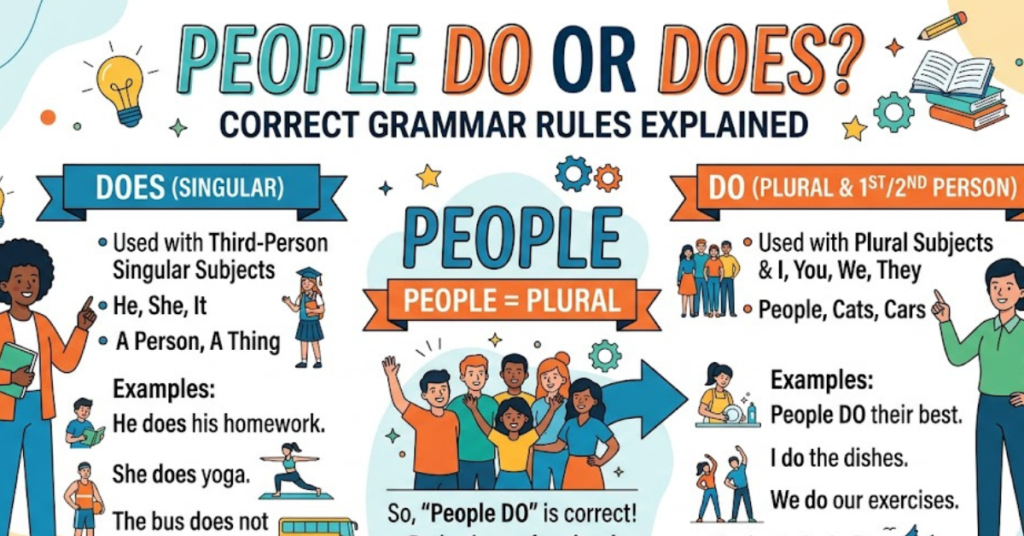
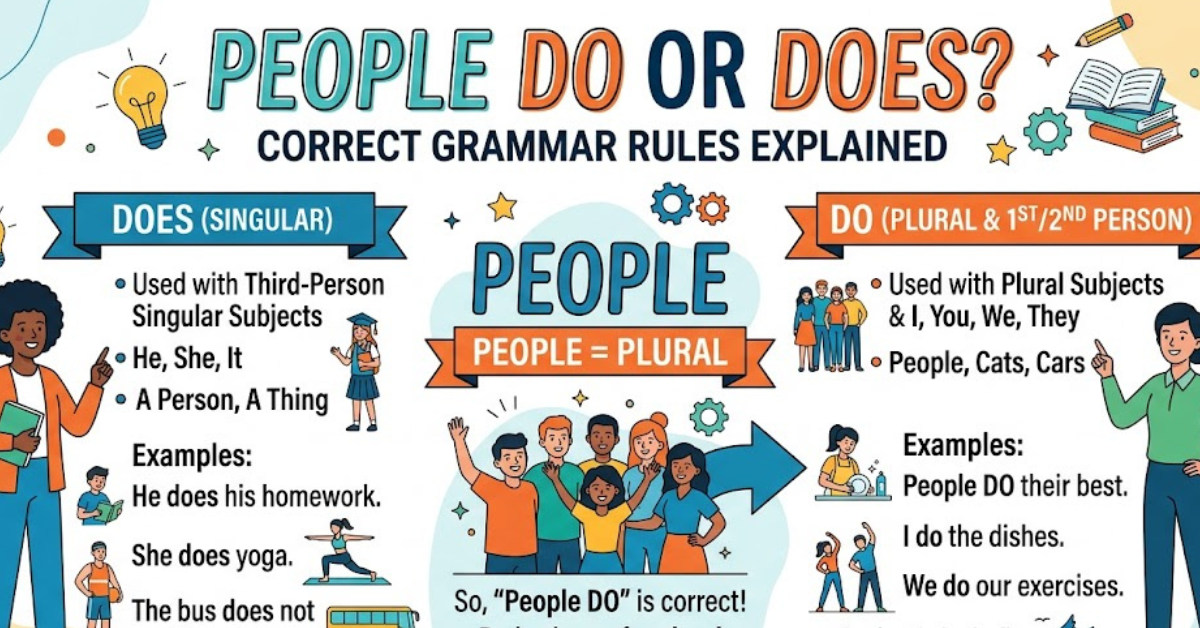
- “Do” is used with plural subjects and pronouns like I, you, we, they, people
- “Does” is used with singular third-person subjects like he, she, it, John, the student
Since “people” is plural, the correct form is always:
People do (not people does)
Example:
- Correct: People do many things to stay healthy.
- Incorrect: People does many things to stay healthy.
Subject-Verb Agreement with “Do” and “Does”
Understanding subject-verb agreement rules in English helps avoid mistakes like this.
When to Use “Do”
Use do with:
- I
- You
- We
- They
- People (plural noun)
- Plural nouns (dogs, students, cars)
Examples:
- People do care about climate change.
- They do their homework daily.
- We do our best in exams.
When to Use “Does”
Use does with:
- He
- She
- It
- Singular nouns (a person, the teacher, my friend)
Examples:
- He does his work on time.
- She does not like coffee.
- The dog does tricks.
Why “Peoples Does” Is Incorrect
A common mistake learners make is treating “people” as a singular noun because it refers to a group. However, grammatically, peoples is always plural.
So saying “people does” breaks the subject-verb agreement rule.
Quick tip:
If you can replace the subject with they, you must use do.
- People = They → They do
- Therefore: People do
Common Mistakes with Do vs Does
Here are some frequent errors and how to fix them:
- Peoples does not understand this rule
Peoples do not understand this rule - Does peoples like this movie?
Do peoples like this movie? - Peoples does a lot of work daily
Peoples do a lot of work daily
Easy Tricks to Remember Do vs Does
To make it stick, use these memory shortcuts:
- DO = plural subjects (more than one)
- DOES = singular he/she/it
- Think: “He does, everyone else do”
Another helpful trick:
If the sentence sounds like it needs “s” on the subject (he, she, it), then the verb also gets “-es” → does.
Real-Life Examples of “People Do”
Let’s see how native speakers naturally use it:
- Peoples do strange things when they are nervous.
- Peoples do better when they feel confident.
- Peoples do not always say what they think.
These examples show how common and natural the correct usage is in everyday English.
FAQs About “People Do or Does”
1. Is it correct to say “peoples does”?
No. “Peoples does” is incorrect because “people” is plural. The correct form is peoples do.
2. Why do we use “do” with peoples?
We use “do” because “peoples” refers to more than one person, making it a plural subject.
3. Can “does” ever be used with peoples?
No, “does” is only used with singular subjects like he, she, or it—not with “peoples.”
4. What is the difference between do and does?
“Do” is used with plural subjects, while “does” is used with singular third-person subjects.
5. How can I quickly remember when to use do or does?
Remember this simple rule:
- He/She/It = does
- Everyone else (including people) = do
Conclusion
The confusion around peoples do or does is common, but the rule is actually very simple: people is always plural, so it always takes “do.”
By understanding basic subject-verb agreement, you can avoid one of the most frequent grammar mistakes in English. Keep practicing with real examples, and soon it will feel completely natural.