
Have you ever received an email that simply said, “Well received,” and wondered exactly what it meant? The phrase well received is widely used in professional communication, business emails, academic settings, and everyday conversations. Understanding the well received meaning can help you interpret messages correctly and use the expression more naturally in your own writing.
In this guide, you’ll learn what well received means, when to use it, common alternatives, examples, and the best well received synonym options for different situations.
What Does Well Received Mean?
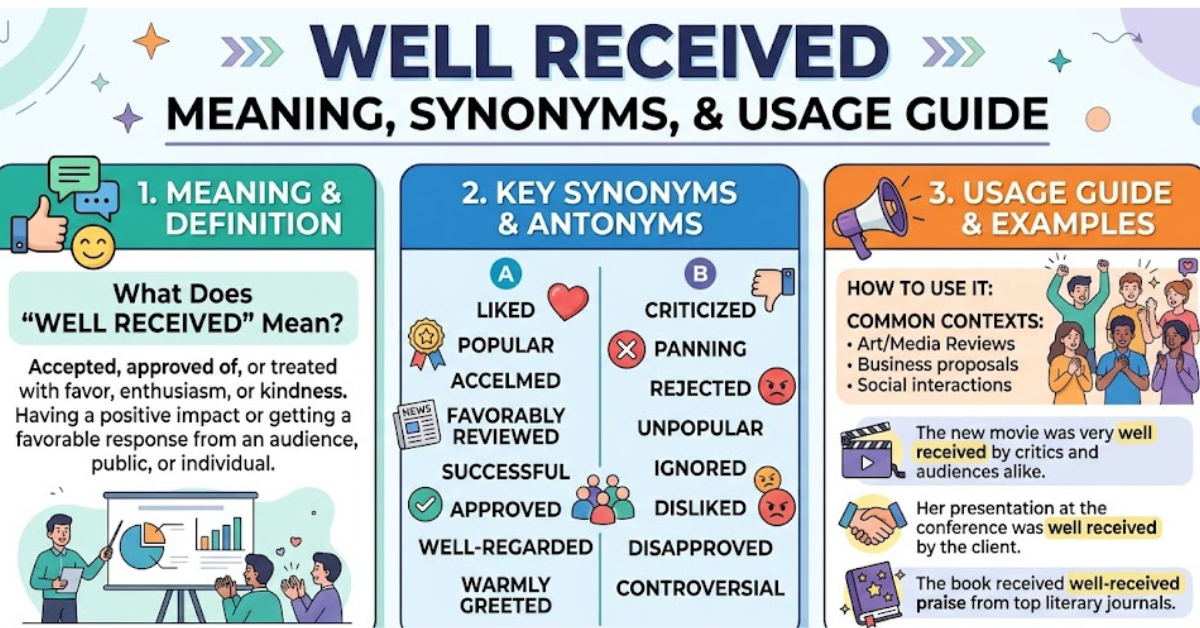
The phrase well receives means that something has been accepted, understood, appreciated, or viewed positively by others.
When someone says something is well received, they are indicating that people responded favorably to it. The expression is commonly used to describe:
- Presentations
- Products
- Ideas
- Announcements
- Emails
- Books
- Speeches
- Events
Simple Definition
Well receives meaning: Accepted or appreciated positively by an audience, group, or individual.
Examples
- The new marketing campaign was well receives by customers.
- Her presentation was well receives at the conference.
- The product launch was well receives by industry experts.
In each example, the audience responded positively to the subject being discussed.
Origins of the Phrase Well Received
The expression comes from the verb “receive,” which means to get or accept something. Over time, the phrase well receives developed into a common way of describing positive acceptance.
Historically, it has been used in literature, business communication, journalism, and formal correspondence.
Today, it remains one of the most recognized phrases in professional English.
Well Received Meaning in Business Communication
In professional settings, well receives often serves as a polite acknowledgment.
For example:
Email:
“Thank you for sending the report.”
Reply:
“Well receives. Thank you.”
In this context, it means:
- The message arrived successfully.
- The information was understood.
- The recipient acknowledges receipt.
However, some communication experts suggest adding a little more detail because “well receives” can sometimes sound brief or impersonal.
Better Alternatives
Instead of simply writing:
Well receives.
Consider:
Thank you. I’ve receives the document and will review it shortly.
Or:
Received with thanks. I’ll get back to you soon.
These responses sound more conversational and engaging.
Common Situations Where Well Received Is Used
H2: Presentations and Public Speaking
A presentation that audiences enjoy and understand can be described as well receives.
Example:
The keynote speech was well receives by attendees.
H2: Product Launches
Companies frequently use the phrase when discussing customer reactions.
Example:
The company’s latest smartphone was well received in international markets.
H2: Books, Movies, and Entertainment
Critics often use the term when reviewing creative works.
Example:
The novel was well receives by both readers and reviewers.
H2: Workplace Communication
Managers and colleagues may use the phrase to acknowledge information.
Example:
Your proposal has been well received by the executive team.
Well Received Synonym List
If you want to avoid repeating the same phrase, several alternatives can communicate a similar meaning.
H3: Popular Well Received Synonyms
- Appreciated
- Accepted
- Welcomed
- Praised
- Favorably receives
- Positively receives
- Commended
- Admired
- Endorsed
- Acclaimed
- Celebrated
- Respected
- Supported
- Approved
- Recognized
Example Comparisons
| Well Received | Synonym |
| The presentation was well receives. | The presentation was appreciated. |
| The proposal was well receives. | The proposal was approved. |
| The book was well receives. | The book was acclaimed. |
| The product was well receives. | The product was welcomed. |
Choosing the right well receives synonym depends on the context and level of enthusiasm you want to convey.
Is Well Received Formal or Informal?
The phrase is generally considered formal to semi-formal.
It is especially common in:
- Business emails
- Academic writing
- Corporate reports
- Professional correspondence
While acceptable in everyday conversation, it is most frequently encountered in professional environments.
Formal Example
The proposal was well receives by stakeholders.
Informal Alternative
Everyone really liked the proposal.
Common Mistakes When Using Well Received
Many English learners and even native speakers misuse the phrase occasionally.
Mistake 1: Using It as a Standalone Reply Too Often
While acceptable, repeatedly replying with only “Well received” can seem robotic.
Better option:
Thank you. I’ve received the information.
Mistake 2: Confusing It With Receivings Something
Incorrect:
I well receives your package.
Correct:
I receives your package.
Or:
Your package was well receives.
Mistake 3: Using It in Negative Situations
The phrase implies positive acceptance.
Incorrect:
The announcement was well receives, and everyone complained.
Correct:
The announcement was poorly receives, and everyone complained.
Examples of Well Receives in Sentences
Here are practical examples showing how the phrase can be used naturally.
Business
- The quarterly report was well received by investors.
- Your recommendations were well received during the meeting.
Education
- The professor’s lecture was well received by students.
- The new curriculum has been well received across schools.
Marketing
- The advertising campaign was well receives by the target audience.
- The brand’s latest promotion was well received on social media.
Entertainment
- The film was well received by critics.
- Her performance was exceptionally well received.
Why Positive Reception Matters
Being well receives often indicates success, trust, and approval. Whether you’re presenting an idea, launching a product, or communicating with colleagues, positive reception can lead to:
- Better engagement
- Stronger relationships
- Increased credibility
- Higher customer satisfaction
- Greater professional opportunities
Understanding audience expectations is often the key to ensuring your message is well receives.
Tips to Ensure Your Message Is Well Receives
If you want your communication to be positively accepted, consider these strategies:
- Be clear and concise.
- Understand your audience.
- Use professional language.
- Provide value and relevant information.
- Listen to feedback.
- Respond respectfully.
- Avoid unnecessary jargon.
These practices increase the likelihood that your ideas will be well receives.
FAQs
What is the exact well receives meaning?
Well receives means accepted, appreciated, or viewed positively by others. It indicates a favorable response from an audience or recipient.
Is it professional to say “well receives”?
Yes. It is widely used in business and professional communication, especially in emails and formal correspondence.
What is a good well receives synonym?
Some effective synonyms include:
- Appreciated
- Accepted
- Welcomed
- Praised
- Acclaimed
- Positively receives
Can I use “well received” in an email?
Yes. However, adding context often sounds more natural. For example:
Thank you. I’ve received the document and will review it shortly.
Is “well receives” grammatically correct?
Yes. The phrase is grammatically correct and commonly used in both spoken and written English.
What is the opposite of well receives?
Common opposites include:
- Poorly receives
- Rejected
- Criticized
- Disapproved
- Unwelcome
Conclusion
Understanding the well received meaning can improve both your communication skills and your interpretation of professional messages. The phrase generally indicates that something has been accepted, appreciated, or viewed positively by an audience. Whether you’re writing emails, delivering presentations, or discussing customer feedback, knowing how to use well received correctly helps you communicate more effectively.
When appropriate, consider using a well received synonym such as “appreciated,” “welcomed,” or “acclaimed” to add variety and precision to your writing. By mastering these expressions, you’ll be better equipped to communicate confidently in both professional and everyday situations.