
English is full of small grammar choices that confuse even fluent speakers. One of the most common examples is cleverer vs more clever. Both phrases seem correct, both appear in writing, and both are used in everyday conversation. So which one is actually right?
The short answer is simple: both forms are grammatically correct. However, the better choice often depends on tone, style, context, and personal preference. In this article, you will learn the difference between these two comparative forms, how English grammar treats adjectives like “clever,” and when each version sounds more natural.
Understanding Comparative Adjectives in English
Before comparing the two forms directly, it helps to understand how comparative adjectives work.
Comparative adjectives are used when comparing two people, things, or ideas.
Examples:
- Tall becomes taller
- Fast becomes faster
- Smart becomes smarter
For longer adjectives, English usually adds “more” instead of “-er.”
Examples:
- More beautiful
- More interesting
- More comfortable
The confusion begins because “clever” sits somewhere in the middle.
Cleverer vs More Clever: The Basic Difference
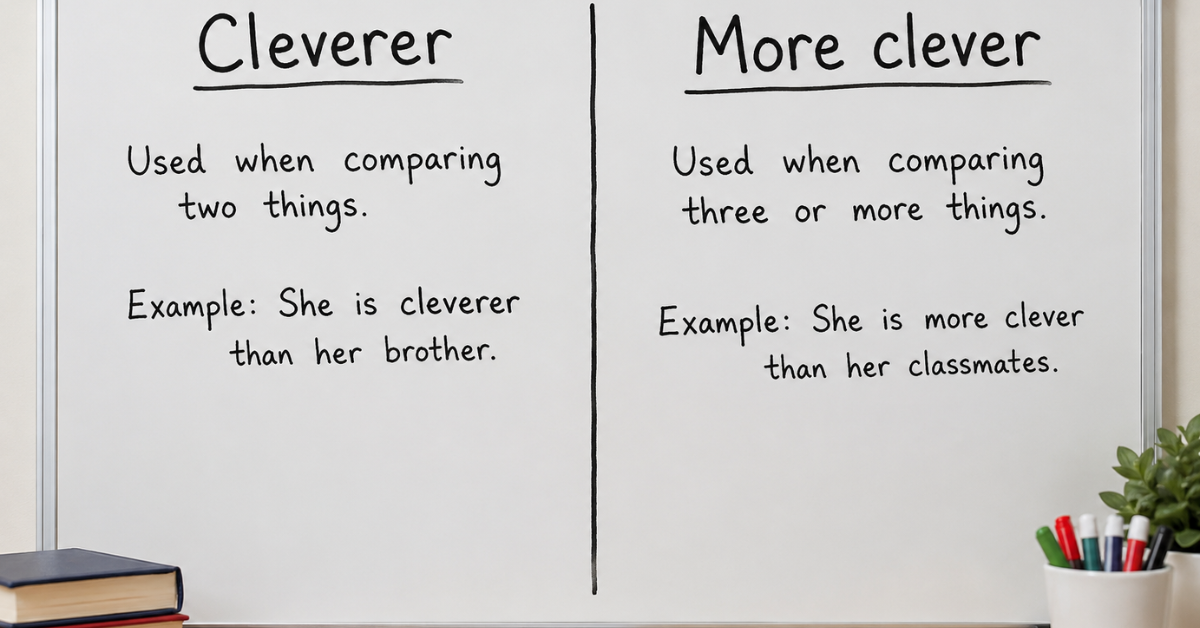
Both “cleverer” and “more clever” mean exactly the same thing. They are both comparative forms of the adjective “clever.”
Examples:
- She is cleverer than her brother.
- She is more clever than her brother.
Both sentences are grammatically acceptable.
The difference is mostly about:
- Style
- Rhythm
- Formality
- Regional preference
- Personal speaking habits
Is “Cleverer” Grammatically Correct?
Yes, absolutely. “Cleverer” is a correct English word and has been used for centuries.
Because “clever” is a two-syllable adjective, English allows two comparative forms:
- Adding “-er”
- Using “more”
This flexibility happens with several adjectives.
Examples:
- Friendly → friendlier or more friendly
- Quiet → quieter or more quiet
- Simple → simpler or more simple
So “cleverer” follows a perfectly valid grammatical pattern.
Why Some People Prefer “More Clever”
Even though “cleverer” is correct, some speakers feel that “more clever” sounds smoother or more natural.
This often happens because:
- The pronunciation feels easier
- It sounds less formal
- Modern speech prefers simpler rhythms
- Certain dialects avoid double syllable endings
In casual conversation, many native speakers naturally choose “more clever” without even thinking about grammar rules.
Which Form Is More Common?
Usage depends heavily on region and writing style.
In British English
“Cleverer” appears more frequently and sounds completely natural to many speakers.
Example:
- He became cleverer with experience.
In American English
“More clever” is often preferred in modern speech and writing.
Example:
- That solution seems more clever.
Neither version is wrong. They simply reflect different language habits.
When to Use “Cleverer”
“Cleverer” works best in:
- Traditional writing
- British-style English
- Literary contexts
- Sentences where brevity matters
Examples:
- The younger student was cleverer than expected.
- She grew cleverer over time.
- His second idea was cleverer than the first.
This form sounds direct and grammatically compact.
When to Use “More Clever”
“More clever” fits naturally in:
- Casual conversation
- American English
- Modern writing styles
- Sentences needing smoother rhythm
Examples:
- That approach feels more clever than practical.
- He sounded more clever during the interview.
- The advertisement was more clever than funny.
This version can feel softer and more conversational.
What Grammar Experts Say
Most grammar guides agree on one important point: both forms are acceptable.
However, style guides sometimes recommend choosing based on readability and natural flow instead of strict grammar rules.
Many modern editors suggest:
- Use whichever sounds more natural in context
- Stay consistent within the same piece of writing
- Prioritize clarity over technical preference
In other words, natural communication matters more than forcing a rule unnecessarily.
Similar Adjectives That Work the Same Way
English contains many adjectives that allow both comparative forms.
Here are some common examples:
| Adjective | Comparative Forms |
|---|---|
| Clever | Cleverer / More clever |
| Quiet | Quieter / More quiet |
| Friendly | Friendlier / More friendly |
| Simple | Simpler / More simple |
| Gentle | Gentler / More gentle |
These flexible adjectives often depend on speaking style and regional preference.
Common Mistakes to Avoid
Although both versions are correct, there are still mistakes learners should avoid.
Using Double Comparatives
Incorrect:
- More cleverer
Correct:
- Cleverer
- More clever
Never combine both comparative structures together.
Overthinking Natural Speech
Many learners become too focused on choosing the “perfect” form. In reality, native speakers use both regularly.
Ignoring Sentence Rhythm
Sometimes one version simply sounds smoother depending on the sentence.
Compare:
- This puzzle is cleverer than the last one.
- This puzzle is more clever than the last one.
One may sound more natural to your ear depending on your accent and speaking style.
How Native Speakers Actually Use These Forms
In real-world English, native speakers usually choose based on instinct rather than grammar analysis.
People often prefer:
- “Cleverer” in writing
- “More clever” in speech
But this is not a strict rule.
Context, tone, and regional habits influence the choice more than textbook grammar.
Tips for Choosing the Right Form
If you are unsure which version to use, these quick tips can help.
Choose “Cleverer” When:
- Writing formally
- Using British English
- Keeping sentences shorter
- Following traditional grammar patterns
Choose “More Clever” When:
- Speaking casually
- Writing conversational content
- Using American English
- Prioritizing smoother flow
Most Important Tip
Use the version that sounds natural to you and fits your audience.
Why This Grammar Question Confuses So Many People
English grammar is not always completely fixed. Some adjectives follow flexible comparative patterns, which creates uncertainty for learners.
The confusion around this topic happens because:
- Both forms are correct
- Different countries prefer different versions
- Spoken English evolves constantly
- Grammar rules are not always absolute
That is why you may hear both versions regularly in movies, books, articles, and conversations.
FAQs About Cleverer and More Clever
Is “cleverer” a real word?
Yes. “Cleverer” is grammatically correct and widely used, especially in British English.
Which is better: cleverer or more clever?
Neither is universally better. Both are correct, and the best choice depends on tone, region, and personal style.
Is “more clever” incorrect?
No. “More clever” is completely acceptable in modern English.
Do native speakers use both forms?
Yes. Native speakers commonly use both, although preferences vary between British and American English.
Can I use “more cleverer”?
No. That is grammatically incorrect because it combines two comparative forms together.
Conclusion
The debate around cleverer vs more clever is less about right and wrong and more about style and natural usage. Both forms are grammatically correct, widely understood, and commonly used by native English speakers.
If you prefer concise traditional wording, “cleverer” works perfectly. If you want a smoother conversational tone, “more clever” may sound better. The most important thing is choosing the form that feels natural in your sentence and matches your audience.
English is flexible in many areas, and this is one of them. Understanding that flexibility makes you not only more accurate but also more confident when using the language.