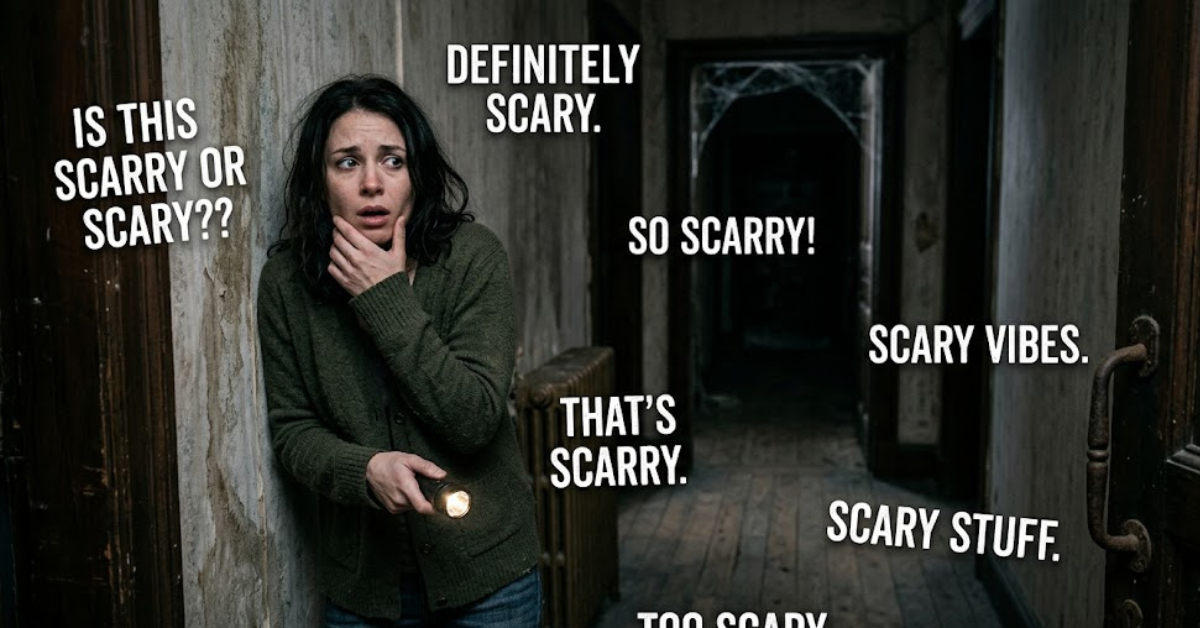

Have you ever paused while typing and wondered whether it should be written as “scarry” or “scary”? You’re not alone. This is one of the most common spelling mistakes in English, especially for learners and casual writers online.
Understanding the difference between scarry or scary is important because only one of these spellings is considered correct in standard English. In this article, we’ll explain the correct usage, explore the scarry or scary meaning, provide examples, and show why this confusion happens so often.
Is It Scarry or Scary?
The correct spelling is:
Scary
The word “scarry” is generally considered a misspelling and is not recognized as a standard English word in dictionaries.
Correct Example:
- “That horror movie was really scary.”
Incorrect Example:
- “That horror movie was really scarry.”
So whenever you want to describe something frightening, creepy, or fear-inducing, the correct word is always “scary.”
What Does Scary Mean?
The word “scary” is an adjective used to describe something that causes fear, nervousness, or discomfort.
Simple definition:
Something that feels frightening or alarming.
Examples:
- Haunted houses are scary at night.
- Watching horror films alone can feel scary.
- Public speaking is scary for many people.
The word is commonly used in both casual conversations and professional writing.
Scarry or Scary Meaning Explained
The confusion around scarry or scary meaning mostly happens because English spelling patterns can be tricky.
Many people assume that because words like:
- carry
- marry
- berry
use double letters, “scary” should also contain two “r” letters. However, English does not follow that pattern in this case.
The correct form remains:
- scary
Not:
- scarry
Why People Misspell “Scary”
English spelling rules can sometimes feel inconsistent. There are several reasons why people accidentally write “scarry.”
1. Pronunciation Confusion
When spoken quickly, “scary” may sound like it contains an extra “r.”
2. Typing Habits
Fast typing often leads to doubled letters unintentionally.
3. Similar English Words
Words with double consonants make people assume the same rule applies here.
This spelling mistake is extremely common online, especially in social media comments and informal writing.
Examples of Correct Usage
Here are some natural examples using the correct spelling:
- “The thunderstorm last night was scary.”
- “I had a scary dream yesterday.”
- “That was the scariest roller coaster I’ve ever ridden.”
- “Some video games are surprisingly scary.”
These examples show how the word fits naturally into everyday English.
Common Situations Where People Use “Scary”
The word “scary” appears frequently in conversations related to:
- Horror movies
- Haunted places
- Fearful situations
- Dangerous experiences
- Anxiety and emotions
It can describe both real and imaginary fears.
Examples:
- A scary dog
- A scary movie
- A scary experience
- A scary sound
The word is highly flexible and commonly used worldwide.
Similar Words Related to Scary
To better understand the meaning, it helps to know similar words.
Synonyms:
- Frightening
- Terrifying
- Creepy
- Alarming
- Spooky
Opposites:
- Safe
- Comforting
- Calm
- Pleasant
Using synonyms can improve your writing variety and vocabulary.
Grammar Tips to Avoid Spelling Mistakes
If you often confuse spellings like “scarry” and “scary,” these simple tips can help:
Read More Frequently
Regular reading improves spelling recognition naturally.
Use Spell Check Tools
Most modern devices automatically detect misspellings.
Learn Common Patterns
Focus on memorizing frequently confused words.
Practice Through Writing
Repeated use helps correct spelling become automatic.
Small habits make a big difference in improving written English.
Why Correct Spelling Matters
Correct spelling improves:
- Communication clarity
- Professional writing quality
- Academic performance
- Online credibility
- Search engine visibility for content creators
Even minor spelling errors can sometimes change how readers perceive your writing.
Frequently Asked Questions
Is “scarry” a real word?
No. “Scarry” is generally considered a spelling mistake. The correct spelling is “scary.”
What does scary mean?
“Scary” describes something frightening, creepy, or fear-inducing.
Why do people write “scarry”?
People often confuse the spelling because of pronunciation or because many English words use double consonants.
How do you spell scary correctly?
The correct spelling is:
- scary
Can scary be used for emotions?
Yes. It can describe emotional experiences, situations, movies, or anything that creates fear.
Conclusion
When it comes to scarry or scary, the correct spelling is always “scary.” While the misspelled version appears frequently online, standard English dictionaries only recognize “scary” as correct.
Understanding the proper spelling and meaning helps improve both casual and professional writing. Whether you’re describing a horror movie, a frightening experience, or a spooky story, using the correct word makes your communication clearer and more confident.