
English spelling can be confusing, especially when two words look almost identical but only one is commonly correct. That’s the case with emerse vs immerse, a pair that often confuses writers, students, and even native speakers.
At first glance, they seem like variations of the same word, but only one is widely accepted in modern English. Understanding the difference helps you avoid spelling mistakes and write with more confidence.
In this guide, we’ll break down their meanings, usage, and examples so you can clearly see which word to use.
Emersion vs Immersion: The Core Idea
Before comparing emerse vs immerse, it helps to understand the concept behind them.
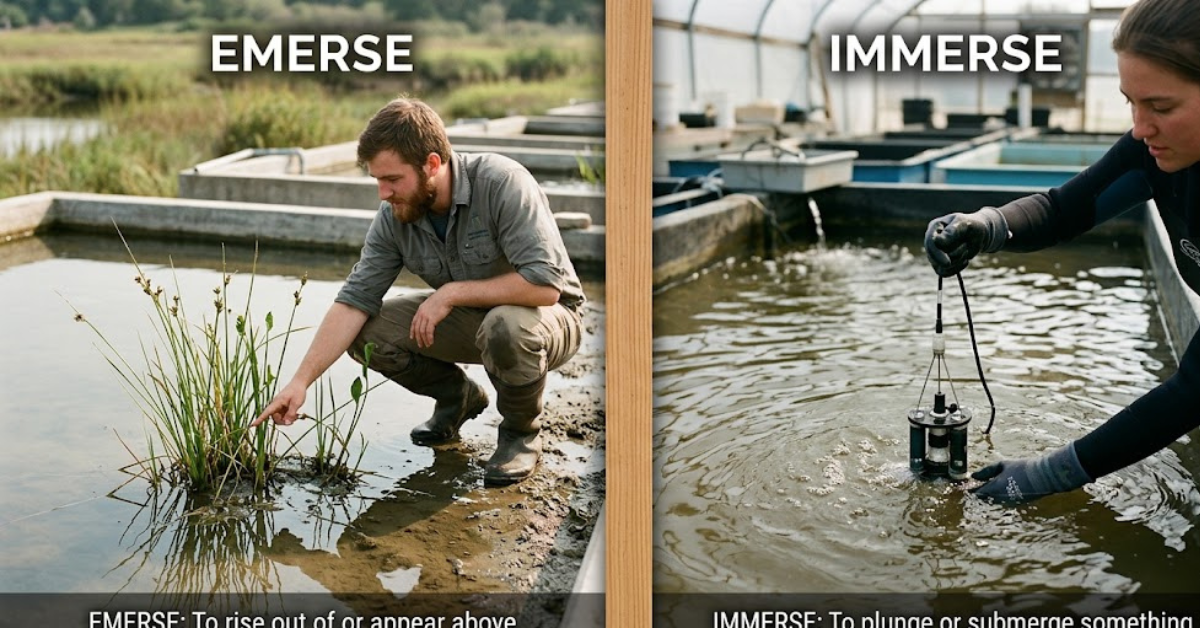
- Immerse means to fully submerge or deeply involve something.
- Emerse is a rare and outdated form that modern English rarely uses.
The key difference is not meaning alone—it’s standard usage in English today.
Immerse Meaning and Usage
The correct and widely accepted word is immerse.
What does “immerse” mean?
It means:
- To put something completely into a liquid
- To involve someone deeply in an activity or experience
- To become fully absorbed in something
Examples:
- She immersed herself in learning Spanish.
- The chef immersed the vegetables in boiling water.
- He immersed himself in his studies.
In all cases, “immerse” shows full involvement or deep engagement.
Is “Emerse” a Real Word?
When people compare emerse vs immerse, confusion often comes from “emerse.”
Technically, “emerse” exists as a very rare or outdated term that means:
- To rise out of a liquid
- To come out or emerge
However, modern English almost always uses “emerge” instead.
Example:
- The turtle emerged from the water.
Writers do not use “emerse” in standard modern writing.
Immersion vs Emerse in Modern Usage
Most people searching for emerse vs immerse actually want to understand correct usage.
Immersion (noun form)
“Immersion” comes from “immerse” and appears frequently in everyday English.
Examples:
- Language immersion programs
- Cultural immersion experiences
- Total immersion in a subject
Usage summary:
- Immerse → correct and standard
- Emerse → outdated or rarely used
In most cases, you should avoid “emerse” entirely.
Why People Confuse the Two
The confusion usually comes from:
- Similar spelling patterns
- Mishearing the word in conversation
- Mixing up “immerse” and “emerge”
- Limited exposure to formal writing
English contains many similar-looking words, so mistakes happen easily.
Common Examples of “Immerse”
Here’s how you’ll see “immerse” used in different contexts:
Academic:
Students immerse themselves in research before exams.
Cultural:
Travelers immerse themselves in local traditions.
Emotional:
She immersed herself in music to relax.
Technical:
Engineers immerse components in a cooling solution.
Each example shows full involvement or deep focus.
Simple Rule to Remember
If you ever feel unsure about emerse vs immerse, use this rule:
- Always use immerse
- Use emerge when you mean “to come out”
This removes confusion in both writing and speech.
Tips to Avoid the Mistake
You can avoid errors with a few simple habits:
- Link “immerse” with “inside completely”
- Link “emerge” with “coming out”
- Avoid using “emerse” in formal writing
- Double-check spelling in professional content
These small steps improve accuracy quickly.
FAQs
Is “emerse” a correct English word?
It exists in rare historical usage, but modern English does not commonly use it.
What is the correct spelling?
“Immerse” is the correct and standard spelling.
What does “immerse” mean?
It means to fully involve or submerge something physically or mentally.
Is “emerse” used in academic writing?
No. Academic writing uses “immerse” or “emerge,” not “emerse.”
Why do people confuse them?
Because they look similar and sound close to “emerge.”
Conclusion
The confusion around emerse vs immerse is common, but the answer is simple. Modern English uses immerse, while “emerse” is outdated and rarely seen.
If you want clear and professional writing, always choose “immerse.” It works in academic, emotional, cultural, and technical contexts.
Once you learn this difference, you won’t second-guess it again—and your writing will instantly feel more polished and accurate.