
Have you ever paused while writing and wondered whether it should be “all is” or “all are”? You’re not alone. This is one of the most common grammar questions in English, and the answer isn’t always as straightforward as people expect.
The phrase all is or all are depends on what the word all refers to in a sentence. Sometimes all represents a singular idea, while other times it refers to multiple people or things. Understanding this distinction can instantly improve your writing and help you communicate more clearly.
In this guide, you’ll learn the grammar rules, see practical examples, avoid common mistakes, and gain confidence in using all is and all are correctly.
Understanding the Word “All”
Before deciding between all is or all are, it’s important to understand how the word all functions in English.
The word all can refer to:
- A whole amount or quantity
- A group of people
- Multiple objects
- An entire situation or concept
Because all can represent either a singular or plural meaning, the verb that follows must match the intended meaning.
Basic Rule
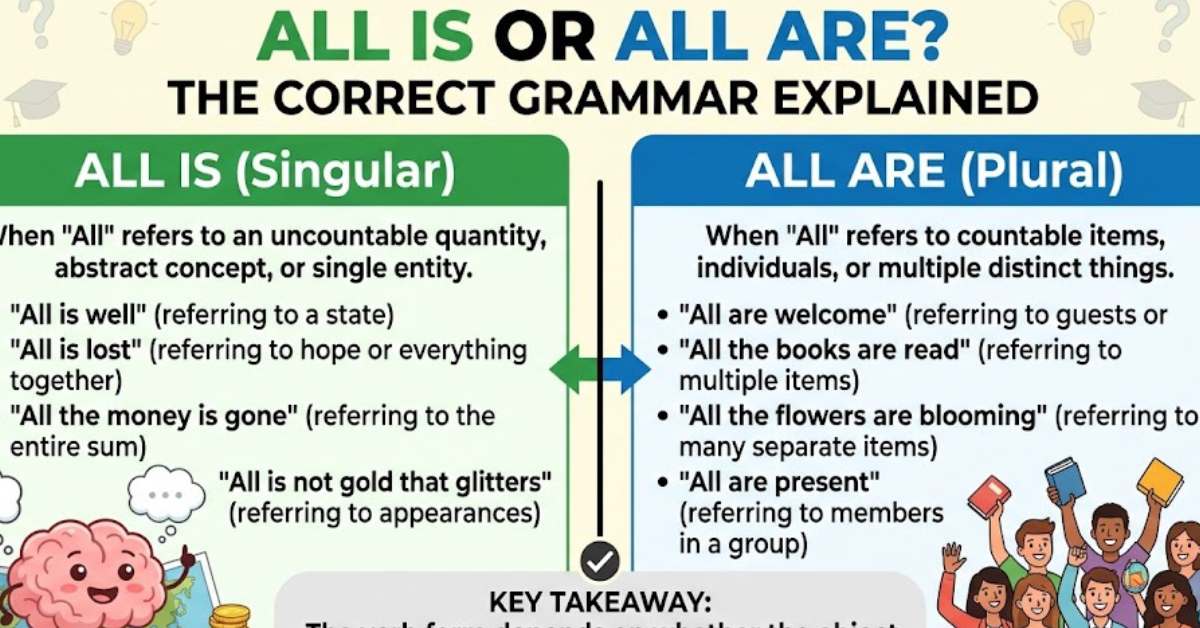
- Use all is when referring to a singular thing, amount, or concept.
- Use all are when referring to multiple people or countable items.
When to Use “All Is”
Use all is when all represents a single whole, an uncountable noun, or an entire situation.
Examples of “All Is”
- All is well.
- All is lost.
- All is ready for the presentation.
- All is under control.
- All is quiet tonight.
In these examples, all refers to a complete situation rather than multiple individual items.
“All Is” with Uncountable Nouns
Uncountable nouns often require singular verbs.
Examples:
- All of the water is gone.
- All of the information is accurate.
- All of the money is spent.
- All of the furniture is new.
Since water, information, money, and furniture are treated as singular quantities, is is the correct choice.
When to Use “All Are”
Use all are when all refers to multiple people, animals, or countable objects.
Examples of “All Are”
- All are welcome.
- All are invited to attend.
- All are present today.
- All are responsible for the outcome.
- All are excited about the trip.
Here, all clearly refers to multiple individuals, making the plural verb are correct.
“All Are” with Countable Nouns
Examples:
- All of the students are here.
- All of the books are on the shelf.
- All of the employees are working remotely.
- All of the apples are ripe.
Because students, books, employees, and apples are countable and plural, are must be used.
All Is or All Are: Easy Comparison Table
| Situation | Correct Form | Example |
| Whole situation | All is | All is well. |
| Uncountable noun | All is | All of the milk is gone. |
| Group of people | All are | All are welcome. |
| Multiple objects | All are | All of the chairs are occupied. |
| Entire concept | All is | All is forgiven. |
How Context Changes the Answer
One reason the all is or all are question causes confusion is that context can completely change the correct choice.
Consider these examples:
Example 1
- All of the cake is gone.
Here, cake is treated as a single quantity.
Example 2
- All of the cupcakes are gone.
Since cupcakes are individual countable items, the plural verb is required.
Example 3
- All of the equipment is ready.
- All of the tools are ready.
The first sentence uses an uncountable noun, while the second uses a countable plural noun.
Common Expressions Using “All Is”
Several popular English expressions naturally use all is.
Examples include:
- All is fair in love and war.
- All is not lost.
- All is calm.
- All is forgiven.
- All is well that ends well.
These phrases have become fixed expressions in English and always take the singular verb.
Common Expressions Using “All Are”
Likewise, many common phrases use all are because they refer to groups of people.
Examples include:
- All are welcome.
- All are invited.
- All are encouraged to participate.
- All are eligible to apply.
- All are expected to comply.
These expressions focus on multiple individuals rather than a single concept.
Common Mistakes to Avoid
Even native English speakers sometimes make mistakes when choosing between all is and all are.
Mistake #1: Looking Only at “All”
Incorrect:
- All are well.
Correct:
- All is well.
The phrase refers to the overall situation, not multiple people.
Mistake #2: Ignoring the Noun After “Of”
Incorrect:
- All of the students is here.
Correct:
- All of the students are here.
The noun students is plural, so the verb must be plural.
Mistake #3: Treating Uncountable Nouns as Plural
Incorrect:
- All of the information are correct.
Correct:
- All of the information is correct.
Information is an uncountable noun and takes a singular verb.
Quick Trick to Choose the Correct Form
If you’re unsure whether to use all is or all are, ask yourself:
“What does ‘all’ represent?”
If it represents:
A Single Thing or Quantity
Use is.
Examples:
- All of the food is gone.
- All is ready.
Multiple People or Objects
Use are.
Examples:
- All of the guests are seated.
- All are welcome.
This simple question solves most grammar dilemmas.
Why This Grammar Rule Matters
Correct subject-verb agreement improves:
- Writing clarity
- Professional communication
- Academic assignments
- Business emails
- Content creation
- SEO-focused writing
Using the right verb form helps readers trust your writing and prevents confusion.
FAQs
Is it correct to say “all is well”?
Yes. All is well is a standard English expression. Here, all refers to the overall situation, making the singular verb is correct.
Is it “all are welcome” or “all is welcome”?
All are welcome is correct because it refers to multiple people being welcomed.
Why is “all” sometimes singular and sometimes plural?
The word all can refer to either a singular quantity or multiple items. The verb changes depending on what all represents.
Is “all of the money is” correct?
Yes. Money is an uncountable noun, so the singular verb is should be used.
Is it “all of the people are” or “all of the people is”?
All of the people are is correct because people is plural.
Can “all” be both singular and plural?
Absolutely. The meaning of the sentence determines whether all takes a singular or plural verb.
Conclusion
The answer to all is or all are depends entirely on context. Use all is when referring to a single situation, concept, or uncountable quantity. Use all are when talking about multiple people or countable objects.
A helpful rule to remember is that the verb should agree with what all represents—not with the word all itself. Once you understand this principle, choosing between all is and all are becomes much easier.
If you’re interested in improving your English grammar further, explore related topics such as subject-verb agreement, collective nouns, and common English usage rules to strengthen your writing skills even more.