
Writing a letter or email may seem simple, but the closing can leave a lasting impression. One phrase that often causes confusion is your sincerely. Is it correct? When should it be used? And how does it differ from similar sign-offs like yours faithfully or best regards?
In this comprehensive guide, you’ll learn the meaning of your sincerely, the correct grammatical form, when to use it in professional and personal correspondence, and common mistakes to avoid. Whether you’re writing a business letter, job application, or formal email, understanding this traditional closing can help you communicate more effectively.
What Does “Your Sincerel’y” Mean?
The phrase your sincerely is often used when people are referring to the closing of a formal letter. However, the grammatically correct version is actually “Yours sincerel’y.”
Yours sincerely is a complimentary close used at the end of formal correspondence. It expresses respect, professionalism, and sincerity toward the recipient.
For example:
Dear Mr. Johnson,
Thank you for your time and consideration.
Yours sincerely,
Sarah Smith
In this context, “Yours sincerely” indicates that the writer genuinely means what they have written and respectfully concludes the communication.
Is “Your Sincerely” Correct?
Understanding the Grammar
Many people search for your sincerel’y because they are unsure about the correct wording.
The proper phrase is:
Yours sincerel’y
Incorrect versions include:
Your sincerel’y
You’re sincerel’y
Yours sincere
The word “yours” acts as a possessive pronoun, making the phrase grammatically complete as a traditional letter ending.
When to Use “Yours Sincerel’y”
Formal Business Letters
One of the most common uses of yours sincerel’y is in professional communication.
Use it when:
- Writing to a specific person by name
- Sending job applications
- Responding to official correspondence
- Communicating with clients or business partners
Example:
Dear Ms. Roberts,
I am writing to confirm our meeting next week.
Yours sincerely,
David Carter
Cover Letters and Job Applications
Hiring managers expect professionalism. Using yours sincerel’y in a cover letter demonstrates attention to detail and proper business etiquette.
Example:
Dear Hiring Manager Sarah Williams,
I appreciate your consideration of my application.
Yours sincerely,
Michael Green
Academic and Official Correspondence
Students, researchers, and professionals often use yours sincerel’y when communicating with:
- Professors
- University departments
- Government agencies
- Professional organizations
Yours Sincerely vs. Yours Faithfully
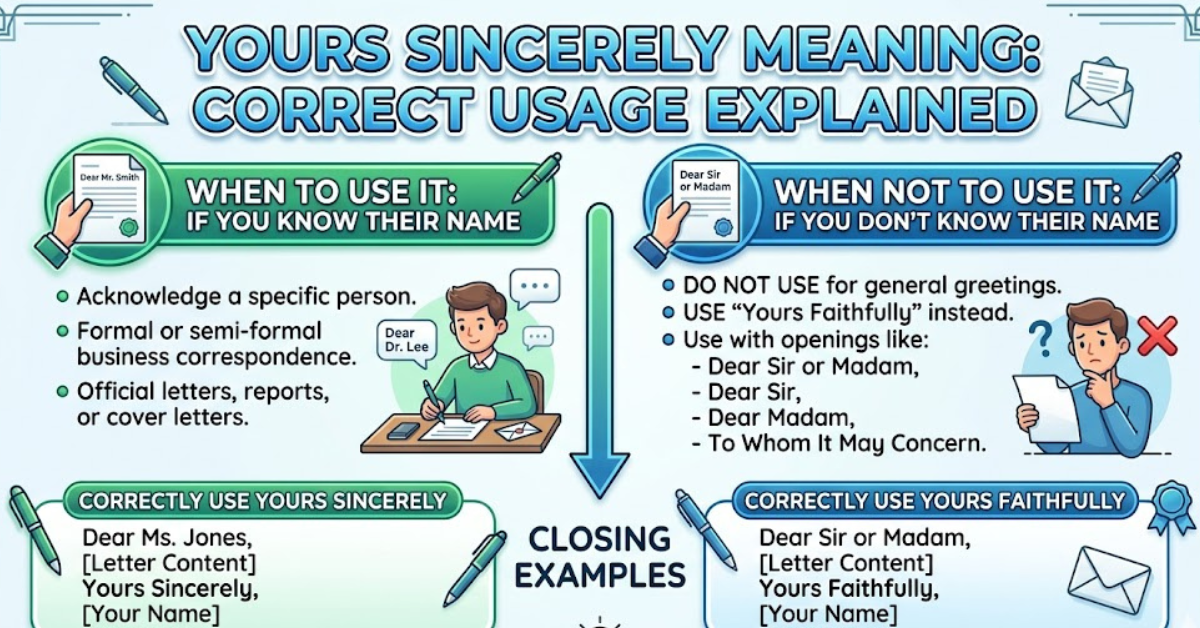
A common question concerns the difference between yours sincerel’y and yours faithfully.
Use “Yours Sincerel’y” When:
You know the recipient’s name.
Example:
Dear Mr. Thompson
Closing:
Yours sincerely
Use “Yours Faithfully” When:
You do not know the recipient’s name.
Example:
Dear Sir or Madam
Closing:
Yours faithfully
This distinction is particularly common in British English.
| Greeting | Closing |
| Dear Mr. Smith | Yours sincerel’y |
| Dear Ms. Johnson | Yours sincerel’y |
| Dear Sir or Madam | Yours faithfully |
Alternative Letter Closings
While yours sincerely remains widely accepted, modern communication often includes alternative sign-offs.
Popular alternatives include:
Professional Alternatives
- Kind regards
- Best regards
- Respectfully
- Warm regards
- Sincerely
Less Formal Alternatives
- Best
- Thanks
- Thank you
- All the best
The choice depends on the level of formality and your relationship with the recipient.
How to Format “Yours Sincerel’y” Correctly
Correct formatting is essential in professional writing.
Standard Letter Format
Dear Mr. Brown,

Thank you for your assistance regarding my inquiry.

Yours sincerely,

Emily Wilson
Email Format
Yours sincerely,

Emily Wilson
Marketing Manager
ABC Company
Formatting Tips
- Capitalize the first word.
- Place a comma after “sincerely” if following your organization’s style guide.
- Leave space for a handwritten signature in printed letters.
- Include your full name underneath.
Common Mistakes to Avoid
When using yours sincerely, watch out for these common errors.
1. Writing “Your Sincerely”
This is the most frequent mistake.
Correct:
Yours Sincerely
Incorrect:
Your sincerely
2. Using the Wrong Closing
Match the closing to the greeting.
Example:
- Dear Mr. Jones → Yours sincerely
- Dear Sir or Madam → Yours faithfully
3. Mixing Formal and Informal Language
Avoid ending a highly formal letter with casual closings like:
- Cheers
- See you
- Talk soon
Professional consistency matters.
Why Letter Closings Still Matter
Despite the rise of instant messaging and social media, professional communication standards remain important.
A strong closing:
- Shows professionalism
- Creates a positive final impression
- Demonstrates attention to detail
- Reinforces respect for the recipient
- Enhances credibility
Employers, clients, and institutions often notice these small but meaningful details.
The History of “Yours Sincerely”
The phrase yours sincerely has roots in traditional letter-writing customs that date back centuries.
Historically, correspondence followed strict etiquette rules. Formal closings were designed to express loyalty, respect, and sincerity toward the recipient. Over time, yours sincerely became one of the most recognized and accepted endings in English-language business communication.
Although modern emails are often shorter and less formal, this classic sign-off remains relevant today.
Best Practices for Professional Correspondence
To make the most of yours sincerely, follow these guidelines:
- Address the recipient correctly.
- Keep your message clear and concise.
- Use professional language.
- Choose an appropriate closing.
- Proofread before sending.
- Include accurate contact information.
These simple practices help create polished and effective communication.
FAQs About Your Sincerely
Is “your sincerel’y” grammatically correct?
No. The correct phrase is “yours sincerel’y.” “Your sincerely” is considered a grammatical error.
When should I use “yours sincerel’y”?
Use yours sincerely when writing to someone whose name you know, especially in formal letters and professional emails.
What is the difference between “yours sincerely” and “sincerely”?
Both are acceptable. However, yours sincerel’y is more traditional and formal, particularly in British English.
Is “yours sincerel’y” still used today?
Yes. It remains a standard closing in business correspondence, official letters, and job applications.
Can I use “yours sincerel’y” in emails?
Absolutely. It is commonly used in professional emails where a formal tone is appropriate.
What should I use if I don’t know the recipient’s name?
Traditionally, use yours faithfully after greetings such as “Dear Sir or Madam.”
Conclusion
Understanding the correct use of your sincerely—or more accurately, yours sincerely—is an important part of professional communication. This traditional closing conveys respect, professionalism, and genuine intent, making it a trusted choice for business letters, cover letters, and official correspondence.
Remember that yours sincerely should be used when you know the recipient’s name, while yours faithfully is generally reserved for situations where the recipient is unknown. By applying proper formatting and avoiding common mistakes, you can leave a strong and positive impression every time you write.
For anyone looking to improve their letter-writing skills, mastering yours sincerely is a small detail that can make a significant difference in how your message is received.